


- About Us
- Our History
-

Overview
Our origins as the first large-scale research facility in the north-eastern United States.
Discoveries
Brookhaven is home to discoveries that led to seven Nobel Prizes.
Unique Facilities
The Lab was conceived to design, construct and operate large scientific research machines.
-
- Awards
- Leadership Team
- Brookhaven Science Associates
- Stakeholder Relations
- External Code of Conduct

R&D 100 Awards
The R&D 100 Awards—called the “Oscars of Innovation”—recognize the 100 most technologically significant products introduced into the marketplace each year. Brookhaven Lab is home to 37 R&D 100 Awards. Brookhaven’s endeavors to transform breakthrough scientific discoveries into game-changing technology—including advances in x-ray imaging techniques, cancer detection, and energy catalysis—have resulted in many R&D 100 recognitions. Brookhaven continues its commitment to partnerships between cutting-edge basic science and commercial deployment to help meet energy challenges, strengthen national security, and stimulate the economy.
See how you can partner with us to create tomorrow’s award-winning innovations.
Recent Brookhaven R&D 100 Awards
 Details
2019
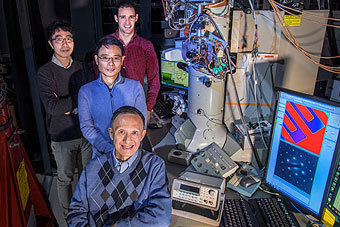
Collaborating scientists developed a solution for imaging materials’ dynamic behaviors, without the need for complex and expensive pulsed lasers.
 Details
2016
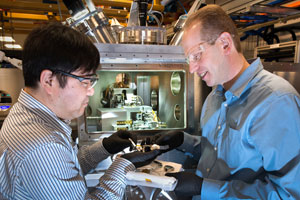
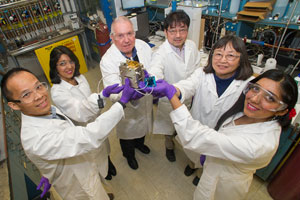
Brookhaven scientists led a team for a custom-built x-ray microscope at the National Synchrotron Light Source II. Advanced x-ray optics provide resolution better than 15 nanometers—50,000 times smaller than a grain of sand.
 Details
2016
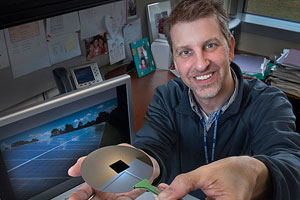
Brookhaven's James Muckerman, Etsuko Fujita, and Kotaro Sasaki, a postdoc, and two high school students developed the low-cost MoSoy Catalyst that eliminates the need for expensive metal catalysts to speed up the rate at which water is split.
 Details
2016
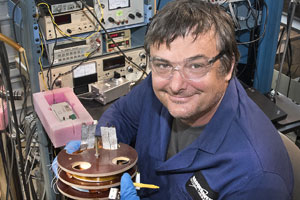
Anti-reflective, water-repellent materials with nanotextured "coatings" developed for a project led by Charles Black at the Center for Functional Nanomaterials could lead to production of highly efficient, self-cleaning solar cells, glare-free cell phone screens, and perfectly transparent windows.
 Details
2015
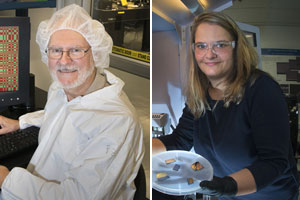
Vyacheslav Solovyov and Qiang Li developed a novel superconducting fault current limiter that can transmit large amounts of electrical energy without added conduction losses and can rapidly interrupt the flow of energy when an emergency occurs.
 Details
2015
Brookhaven's Nathalie Bouet and Peter Takacs developed the Binary Pseudo-Random Calibration Tool with collaborators to solve a difficult problem: the quantitative characterization of the measuring instruments.
 Details
2014
Brookhaven scientists developed a novel radiation detector called GammaScout, a compact system that provides detailed spectroscopic and imaging information about the presence and distribution of x-ray and gamma-ray radiation in a sample.
 Details
2012
Brookhaven chemist Radoslav Adzic and his research team developed durable, high-performing, low-platinum electrocatalysts optimized for use in electric vehicle fuel cells.
 Details
2011
Researchers at the National Synchrotron Light Source and Australia’s Commonwealth Scientific and Industrial Research Organization (CSIRO) developed the Maia x-ray microprobe detector system, capable of imaging everything from Rembrandt paintings to soil deposits 1,000 times faster than previous methods.
 Details
2009
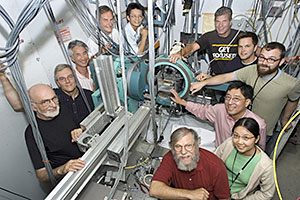
Collaborating with Hybridyne Imaging Technologies, Inc., Brookhaven scientists invented a compact gamma camera called ProxiScan, capable of detecting prostate cancer at an early stage and raising the chances of early diagnosis and treatment.
 Details
2006
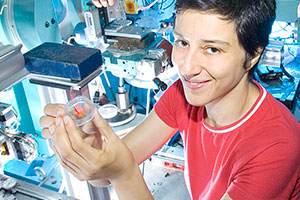
National Synchrotron Light Source scientists developed the Sagittal Focusing Laue Monochromator, the first device able to focus a large spread of high-energy x-rays to study physics, biology, and nanotechnology with superior beam intensity, higher image resolution, and greater efficiency.
 Details
2005
Kansas State University and Yinnel Tech, Inc. collaborated with Brookhaven to create a highly efficient, low-cost portable radiation detector for homeland security applications, nuclear medical imaging, environmental monitoring and cleanup, galactic events studies, and nuclear-weapons safeguards.
