The Apex of RHIC Physics: 2026 Users' Meeting Recap
First Users' Meeting following final collisions at the Relativistic Heavy Ion Collider (RHIC) featured reports on collider's last run, a RHIC retrospective symposium, and preparations for the Electron-Ion Collider
June 11, 2026
By Karen McNulty Walsh and Kelly Lazzaro
 enlarge
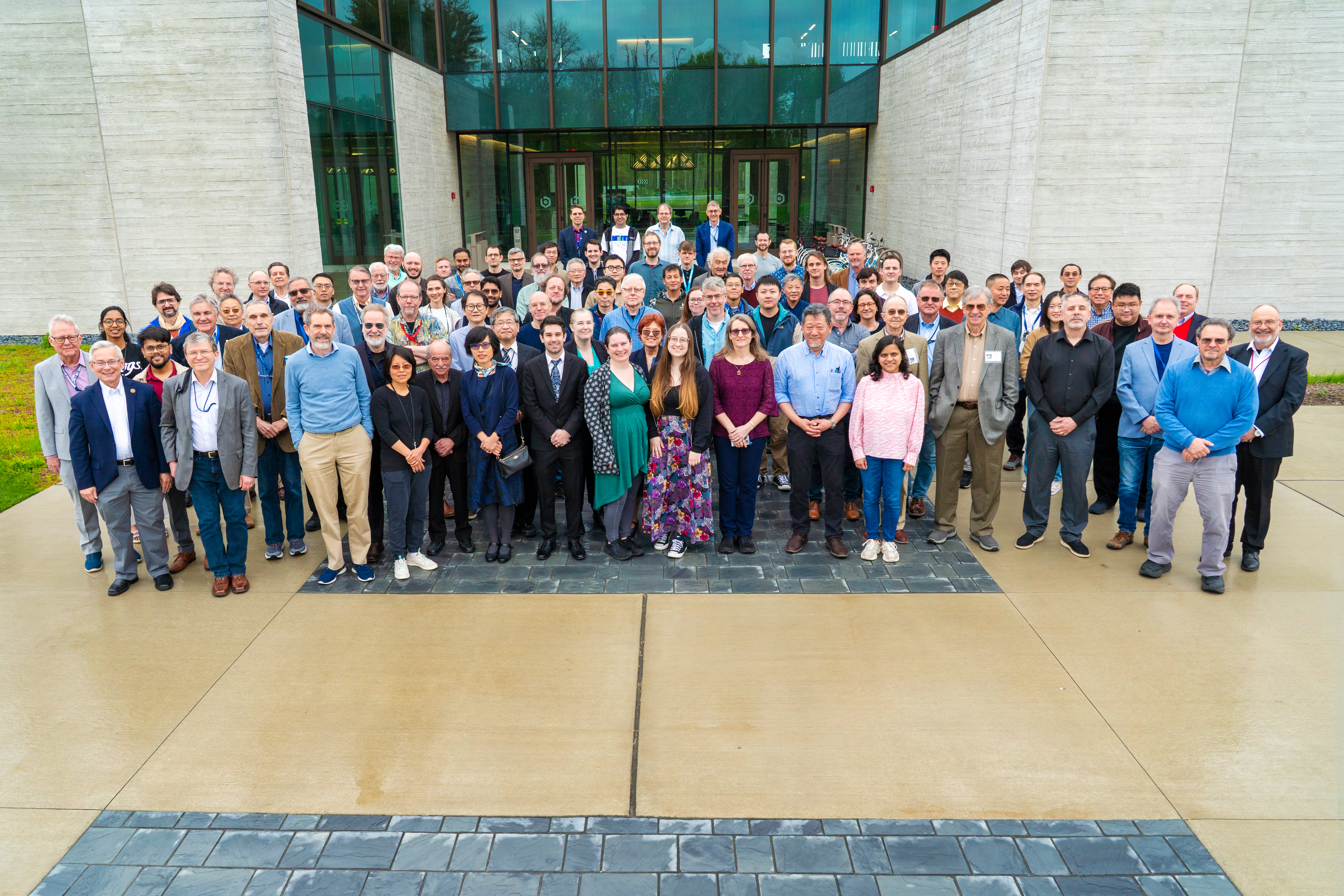
Attendees of the RHIC & AGS Users' Meeting and retrospective RHIC science symposium stand in front of the Science & User Support Center at Brookhaven National Laboratory. (David Rahner/Brookhaven National Laboratory)
Scientists conducting research at the Relativistic Heavy Ion Collider (RHIC), Alternating Gradient Synchrotron (AGS), and the supporting accelerator complex at the U.S. Department of Energy’s (DOE) Brookhaven National Laboratory gathered at the Lab May 11-13 for the annual RHIC & AGS Users’ Meeting. The meeting was organized by the RHIC/AGS Users’ Executive Committee (UEC) and chaired by Ohio State University physicist Daniel Brandeburg, chair-elect of the UEC.
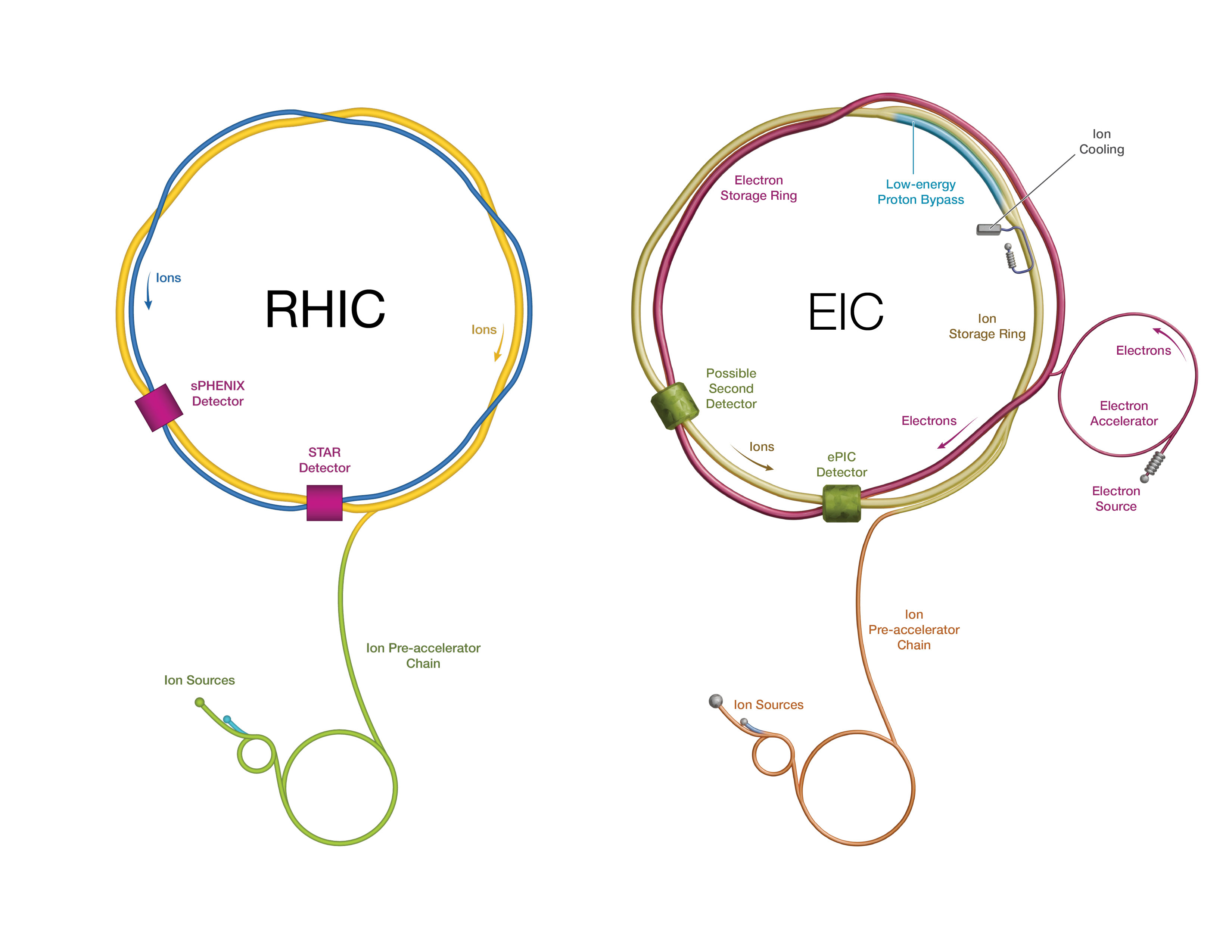
RHIC, a DOE Office of Science user facility for nuclear physics research at Brookhaven, completed a quarter-century of operations this February and is currently being transformed into the Electron-Ion Collider (EIC), a machine with unmatched capabilities for exploring the building blocks of matter. The meeting included presentations on RHIC’s final run, experiment highlights, and in-depth scientific workshops. It was followed May 14-15 by a two-day RHIC symposium with a more historical focus recapping the story of the RHIC program and ending with future-focused sessions on the next phase of RHIC science and the EIC.
 enlarge
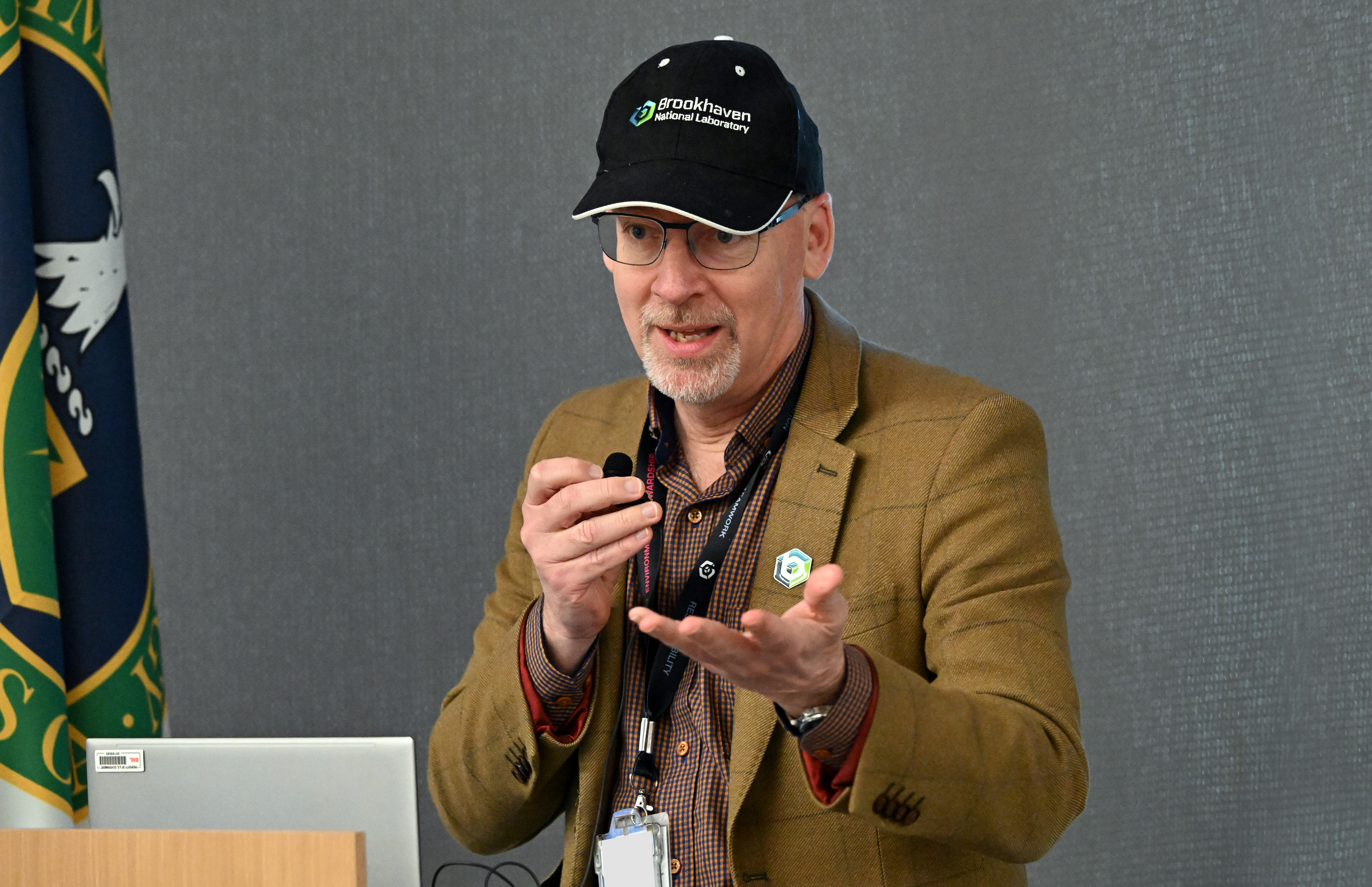
John Hill speaks at the opening plenary session of the RHIC & AGS Users' Meeting on May 12, 2026. Hill, then interim director of Brookhaven National Laboratory, was officially named as the next laboratory director the following week. (Kevin Coughlin/Brookhaven National Laboratory)
“RHIC has been incredibly successful in terms of the science it has produced over the years,” said John Hill, Brookhaven Lab’s then-interim director, at the meeting’s opening plenary session. Hill highlighted the major RHIC discoveries — including the “perfect” liquid nature of the quark-gluon plasma (QGP) and measurement of gluon contributions to proton spin — along with the facility’s productivity in terms of publications, Ph.D.s, massive data sets, and the promise of “discoveries still to come.”
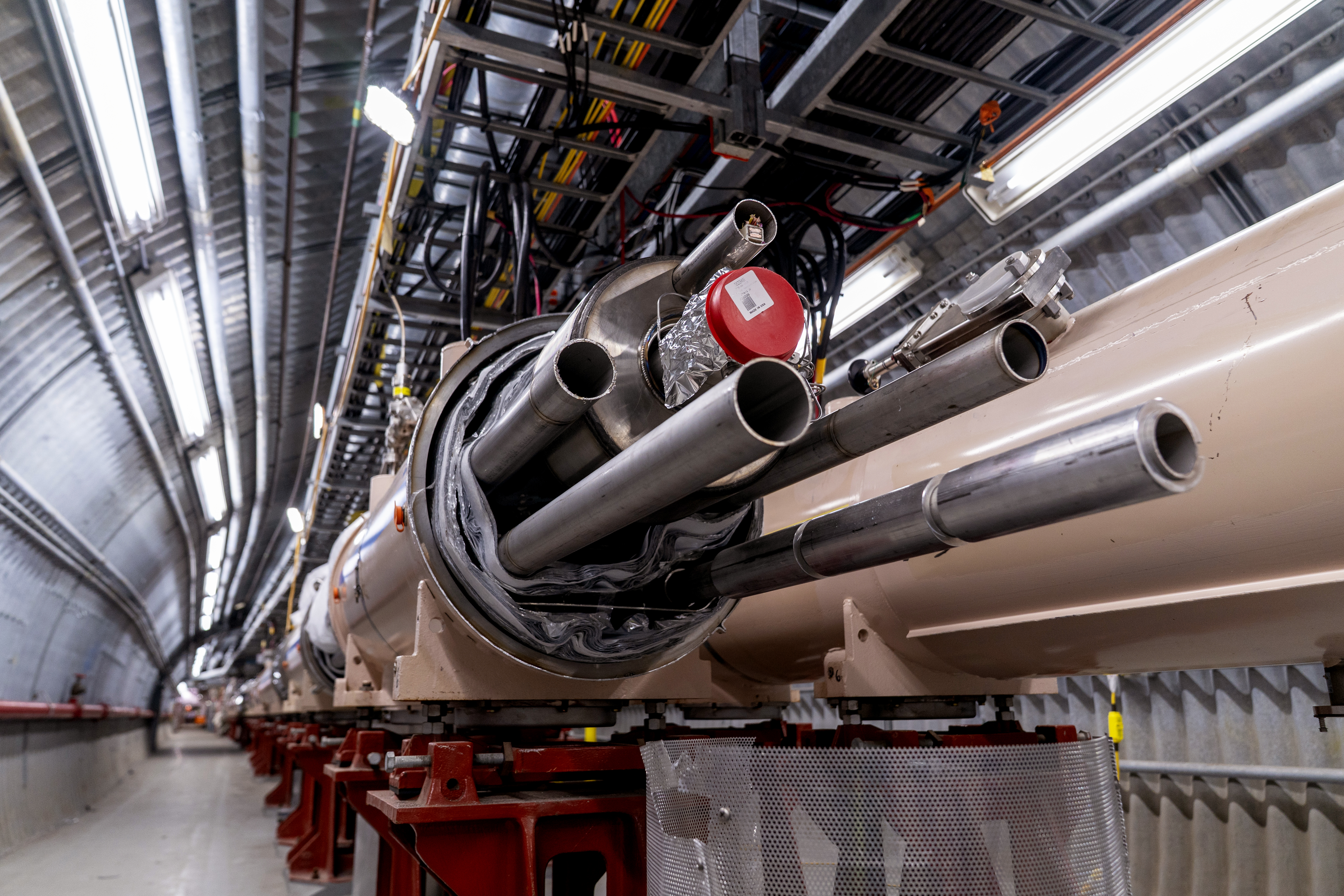
Remarking that the removal of the first cryostat from one of RHIC’s rings was taking place that very day, Hill said that the transition of RHIC to the EIC would progress rapidly over the next decade. “Brookhaven’s number one priority is to deliver this machine to the country and the world, and we are proud and honored to be hosting it,” he said.
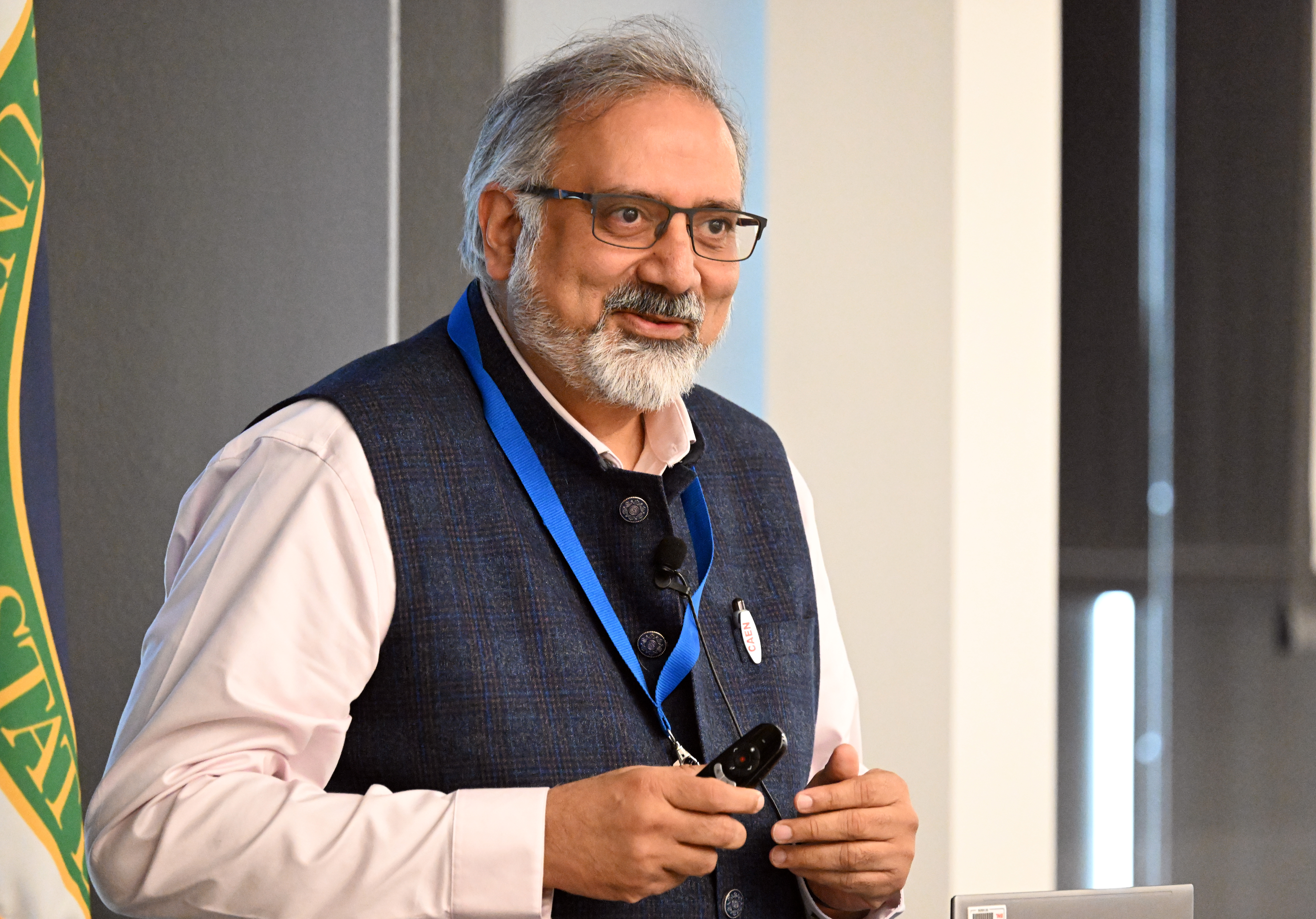
Abhay Deshpande, the Lab’s associate director for Nuclear and Particle Physics and director of science for the EIC, split his plenary session talk into two sections: first, to appreciate “how glorious the 25 years of RHIC operations were,” and then a vision of the “prospects and the promise of the EIC.” He recapped RHIC’s sustained scientific output over more than a quarter century and thanked “all the people involved in making the past a success — the scientists, the engineers who made it real, the technicians and support staff — and not just from this lab, but with other DOE labs who contributed and will collaborate in the future, and the university scientists.”
 enlarge
Brookhaven Lab Associate Laboratory Director for Nuclear and Particle Physics Abhay Deshpande also serves as science director for the Electron-Ion Collider and is a professor at Stony Brook University. (Kevin Coughlin/Brookhaven National Laboratory)
He noted that RHIC is “the world’s most versatile collider that ever ran — ever,” highlighting the brightness of its beams, high collision rates, range of ions collided, wide span of collision energies, and its status as still the only polarized collider in the world. Its discoveries about the QGP and gluon spin raised questions that drew in more physicists eager to explore these mysteries and helped to pave the way for the scientific explorations that will take place at the EIC.
After recapping the “bittersweet” final collision events of Feb. 6, saying, “all good things have to come to an end,” Deshpande outlined some of the major science goals of the EIC.
“If RHIC ‘broke’ the nuclei and the protons, the EIC will slice them,” Deshpande said. “That is what we’re trying to do — precision studies to understand the structure — essentially imaging the inside of the proton or the nuclei.” He elaborated on how these precision studies will allow scientists to discover how the quarks and gluons within each proton and neutron contribute to the mass, spin, and other properties of visible matter.
Deshpande pointed out the important contributions being made by scientists at Brookhaven and collaborating labs and universities across the U.S. and around the world, as well as the funding support from DOE and New York State — all needed to make the EIC a reality.
Noting that the EIC will be the only new collider for the foreseeable future in the U.S., he emphasized that “the machine is unique, and the science is unique.” To scientists wanting to study the remaining problems in quantum chromodynamics (QCD), the theory describing quarks and gluons, he said, “you will have to come to Brookhaven Lab to work on the EIC.”
The DOE perspective
 enlarge
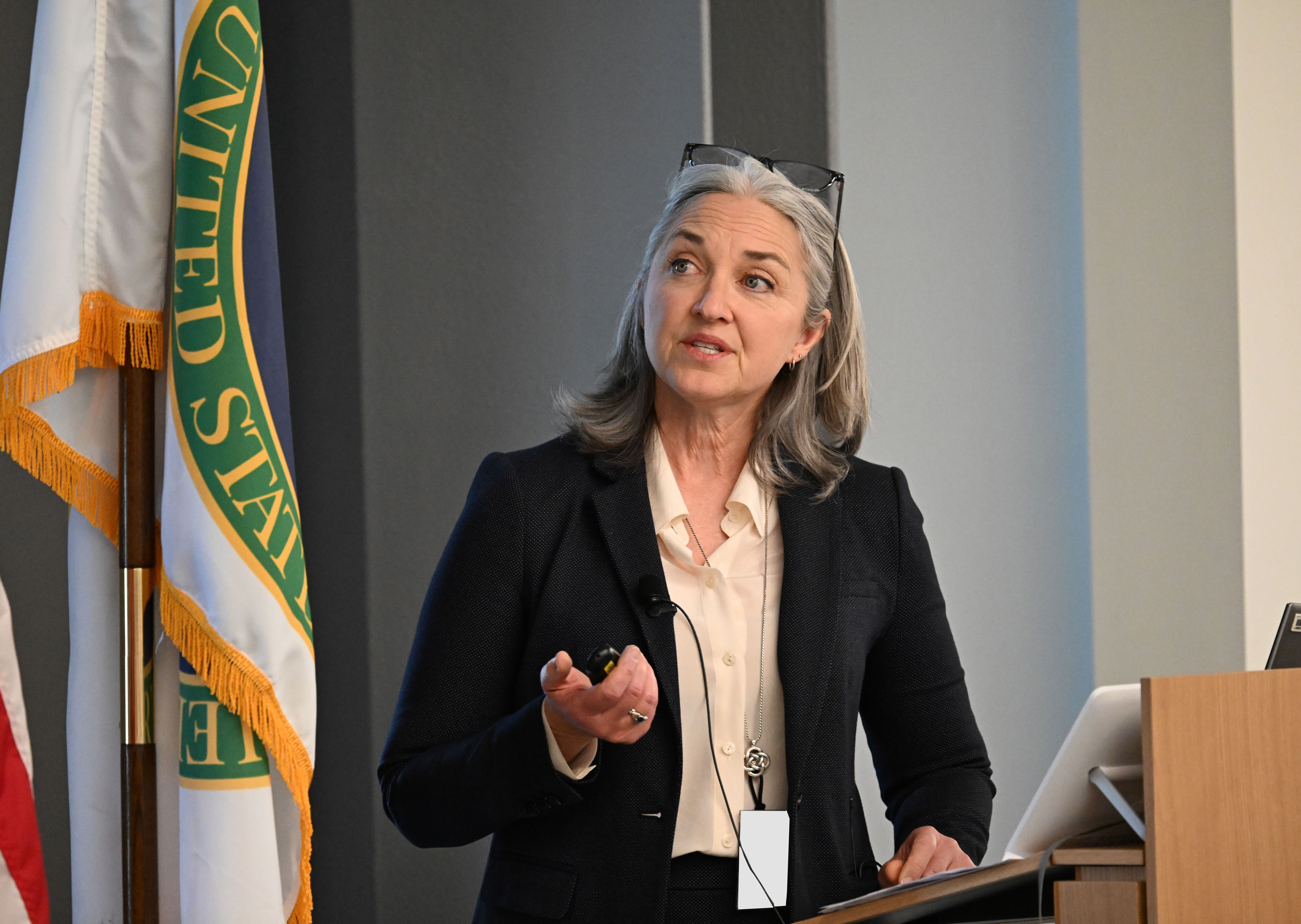
Sharon Stephenson is the physics research director for the soon-to-be-combined Office of High Energy and Nuclear Physics within the U.S. Department of Energy's Office of Science. (Kevin Coughlin/Brookhaven National Laboratory)
Sharon Stephenson, physics research director for what will soon be a combined Office of High Energy and Nuclear Physics in DOE’s Office of Science, picked up on the theme of celebrating “a really big year for RHIC.”
She praised attendees for accomplishing the major goals set out at last year’s meeting: collecting the necessary gold-gold collision data for the sPHENIX collaboration’s science program; continuing production of impactful science results from the STAR and PHENIX collaborations; and efforts to preserve RHIC data to ensure that there’s a way to connect older data to new datasets — collected with new detector capabilities that didn’t exist in RHIC’s early days — and to be able to also analyze that data along with yet-to-be-collected data at the EIC in what she called the “multi-messenger” era.
“That’s a hard challenge!” she acknowledged, saying, “This group is one of the unique groups that can solve it.”
After giving an overview of the research portfolio of the former Office of Nuclear Physics and its mission to “discover, explore, and understand all forms of nuclear matter,” she pointed out how crosscutting capabilities in theory, artificial intelligence (AI), advanced computing, and accelerator and detector research and development underpin the three equal pillars of discovery science in that portfolio.
Her presentation highlighted how user facilities like RHIC and the future EIC provide critical capabilities to maintain U.S. scientific leadership, and she said, “EIC is at the top of the chart and top of mind in terms of the long-range plan.” She highlighted the recent approval of a second phase of spending to purchase materials and equipment needed to build the EIC. She also pointed out the growing international engagement in the EIC, saying, “we value those international partnerships.”
 enlarge
The Relativistic Heavy Ion Collider (RHIC) is currently being transformed into the Electron-Ion Collider (EIC), a new machine for cutting-edge nuclear physics research that the U.S. Department of Energy's Sharon Stephenson called "top of mind in terms of the long-range plan." (Valerie A. Lentz/Brookhaven National Laboratory)
She presented estimated nuclear physics budget numbers for fiscal year 2026, with Brookhaven Lab getting the biggest slice of the pie: $329 million. The funding allotment for fiscal year 27 is projected to be lower, but there’s still uncertainty about where the numbers will land.
Responding to a question about how reduced funding for university-based research squares with the goal of building new facilities like the EIC, which requires the efforts and funding for graduate students and postdoctoral fellows at collaborating universities, Stephenson said, “It’s a concern, a reality, something that we are discussing.” She noted opportunities for support of undergraduate and particularly graduate students, as well as visiting faculty, through programs run by DOE’s Office of Workforce Development for Teachers and Scientists.
Stephenson pointed out the pioneering efforts of nuclear physicists in developing and using AI models and how AI-ready datasets from facilities like RHIC will help accelerate the development of new AI tools and take advantage of them. The recently announced Genesis Mission identifies two National Science and Technology Challenges related to “unifying physics from quarks to the cosmos” and “enhancing particle accelerators for discovery.” Evaluations of a record number of proposals submitted for Genesis are underway. The review process is being carefully documented, she said, and will be described when awards are announced so everyone understands the process.
Stephenson also noted that the Nuclear Physics program has a growing footprint in quantum information science and is strongly aligned with the Brookhaven-led Co-design Center for Quantum Advantage, one of five DOE National Quantum Information Science Research Centers. This coordinated ecosystem is driving advances in quantum computing, networking, sensing, and simulation. By combining infrastructure and expertise across National Labs, academia, and industry, the centers are tackling critical challenges such as scalable quantum systems, distributed quantum networks, and hybrid quantum-classical computing.
 enlarge
A first step in the transformation of the Relativistic Heavy Ion Collider (RHIC) to the Electron-Ion Collider (EIC) — removal and relocation of a cryostat from one of RHIC's ion storage rings — took place during the RHIC & AGS Users' Meeting. (David Rahner/Brookhaven National Laboratory)
RHIC’s final run: a commitment to delivering data
 enlarge
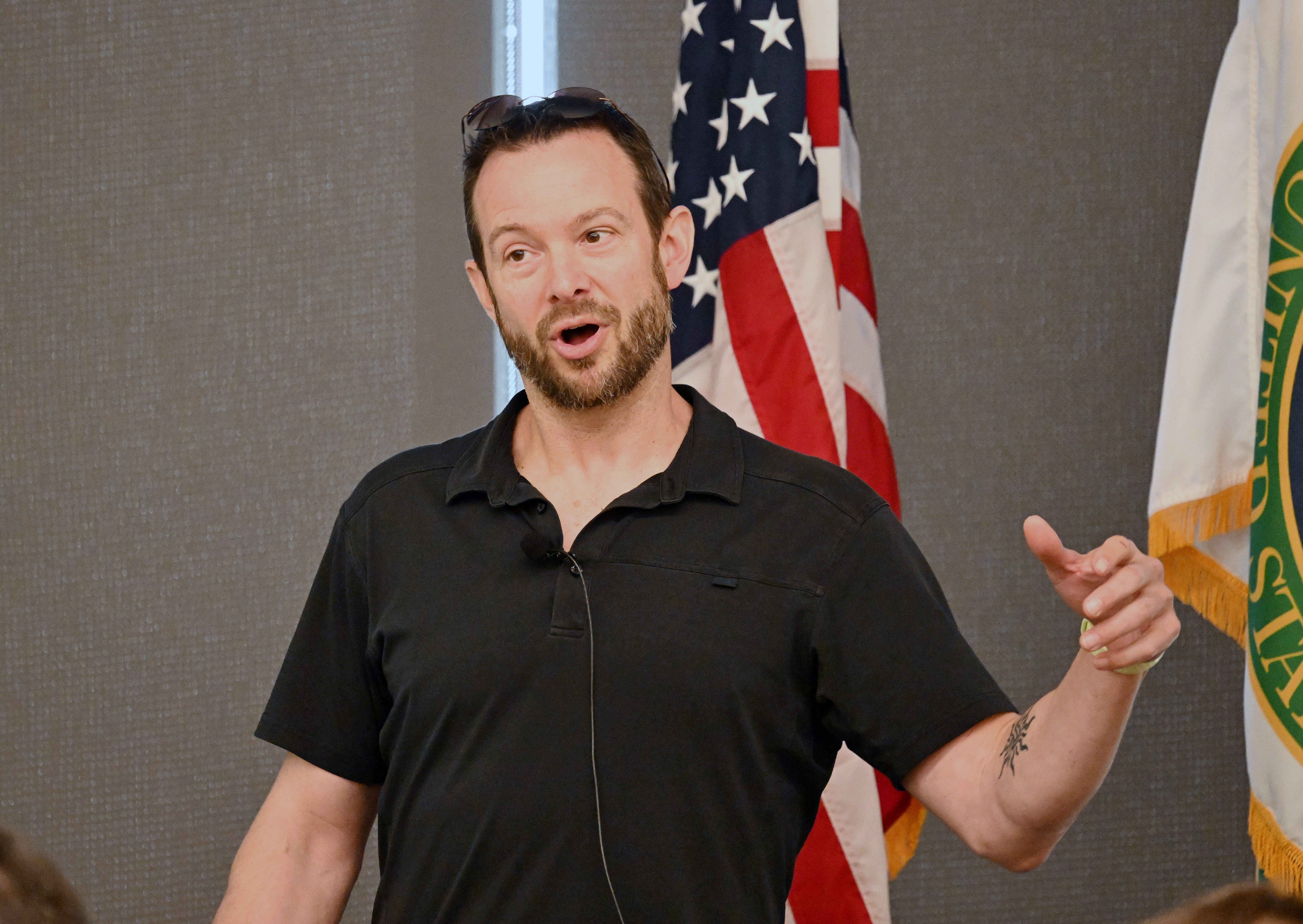
Travis Shrey of Brookhaven Lab's Collider-Accelerator Department recapped the Relativistic Heavy Ion Collider's final three runs with references to "The Lord of the Rings" movie trilogy, complete with clever problem solving, teamwork, and the rise of unsung heroes. (Kevin Coughlin/Brookhaven National Laboratory)
RHIC’s 25th and final run produced more collision data than all its previous years combined. Both of RHIC’s detectors, STAR and sPHENIX, captured key data from gold ion smashups and oxygen-oxygen collisions, while sPHENIX also captured polarized proton-proton data.
“We thought we better run really well in order to hit these goals,” said run coordinator Travis Shrey of the Collider-Accelerator Department (C-AD), which supports RHIC operations.
However, the spectacular data-taking success of Run 25 did not come without challenges. It began with tackling a number of complex technical equipment issues, weather events, and unexpected twists that emerged during Runs 23 and 24. Shrey compared RHIC’s three final runs to “The Lord of the Rings” movie trilogy. And much like the epic journey depicted in those films, his report made it clear that reaching the end of RHIC’s story required clever problem-solving, teamwork, and the rise of unsung heroes.
He specifically noted welders’ “artistic” and precise work on magnets, repairs to electrical infrastructure, and brainstorming sessions focused on delivering intense, stable particle beams throughout the run. The effort paid off for both the STAR and sPHENIX experiments.
 enlarge
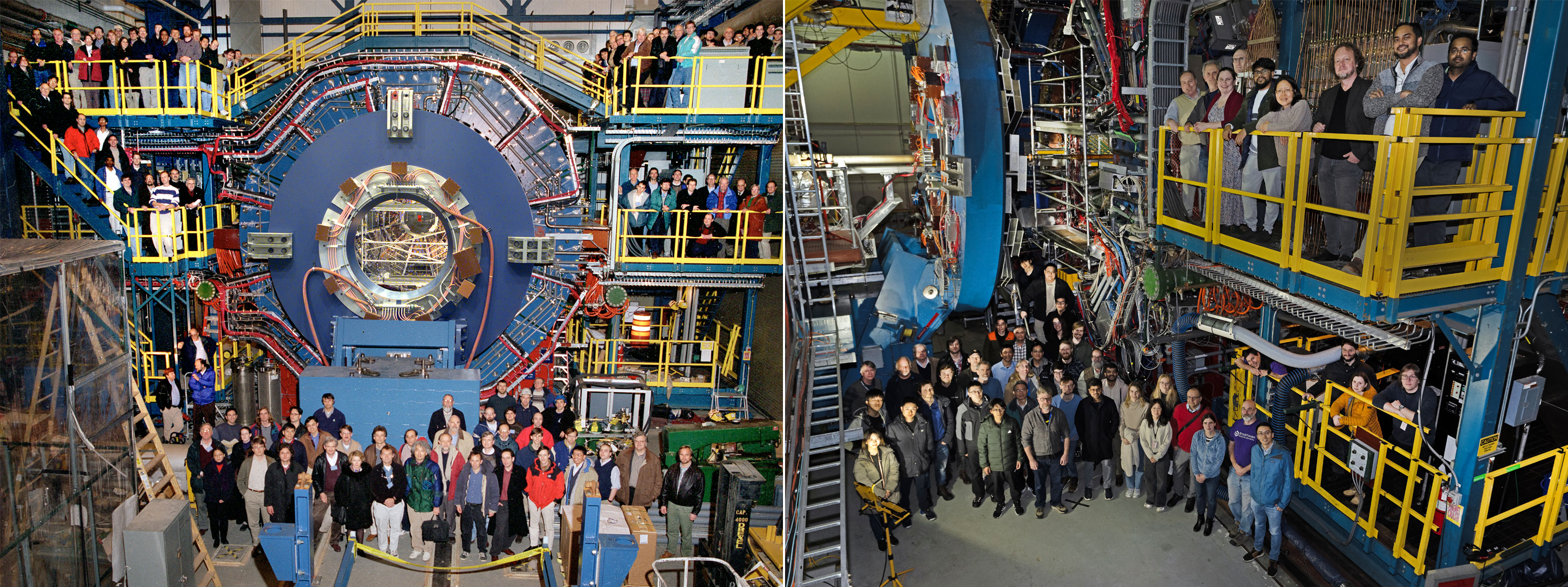
The STAR Collaboration is pictured with their eponymous detector in 1999 at the start of the Relativistic Heavy Ion Colliider program (left) next to a new collaboration photo captured after the completion of the final run in 2026. (Michael Herbert, Kevin Coughlin/Brookhaven National Laboratory)
STAR wrapped up operations with what collaboration member Tristan Protzman of Lehigh University called an excellent Run 25 that completed a legacy dataset. The detector captured gold-gold and proton-proton collisions at a top energy of 200 billion electron volts (GeV), along with low-energy fixed-target gold-gold collisions at 4.2, 4.5, and 5.2 GeV. STAR also recorded oxygen-oxygen collisions at 200 GeV, expanding its Run 21 light-ion dataset for jet and heavy flavor physics. The oxygen-oxygen smashups were a rare example of an ion species collided at both RHIC and the Large Hadron Collider at CERN, the European Organization for Nuclear Research, Protzman noted.
“STAR has already had a very large impact on our understanding of QCD, and these large gold-gold datasets collected in Run 23 and 25, as well as the proton-proton data collected in Run 24, will do a lot to ensure that STAR remains productive scientifically well into the future,” Protzman said.
 enlarge
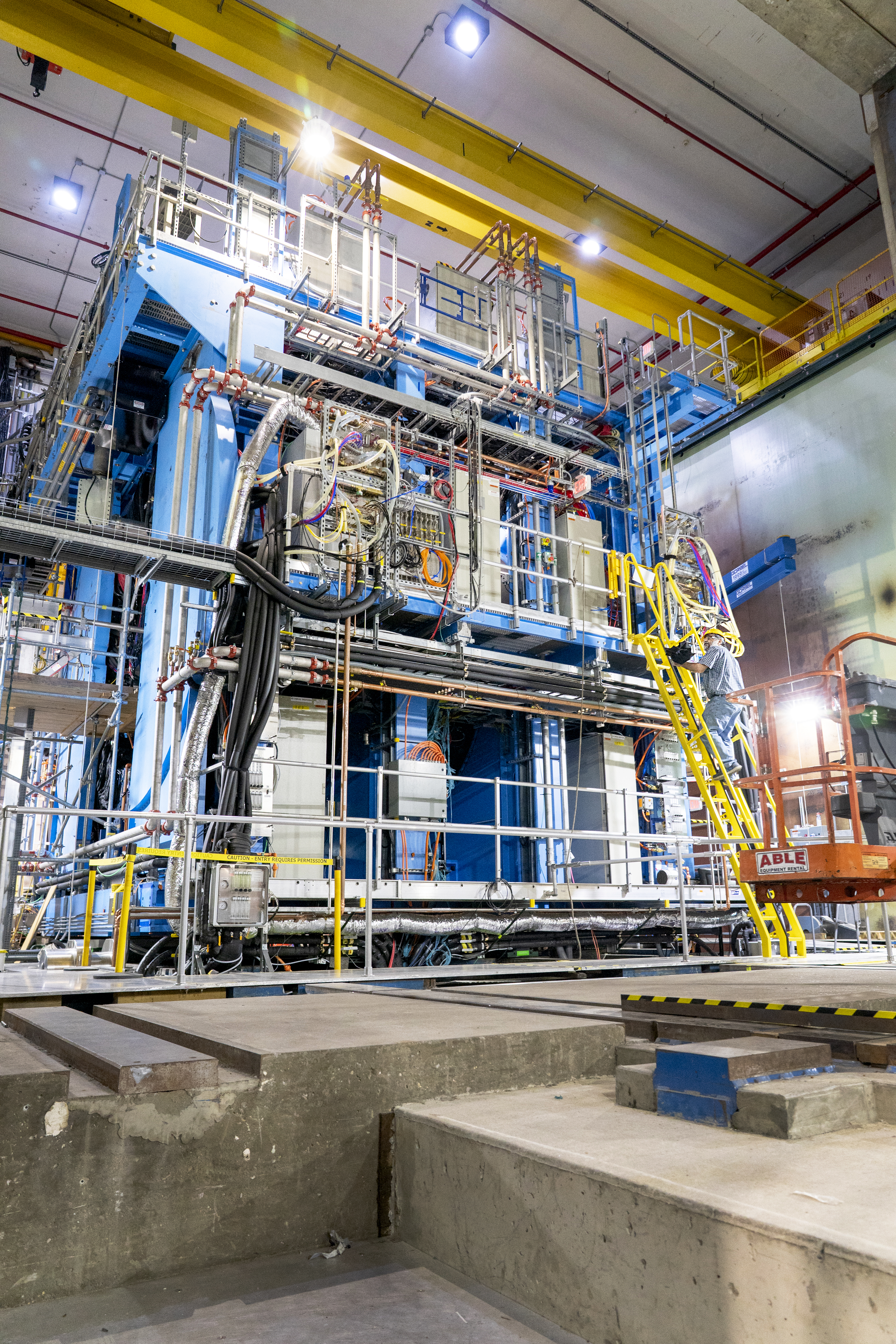
sPHENIX, the Relativistic Heavy Ion Collider's (RHIC) newest detector, collected more than 200 petabytes of data in RHIC's final run — considerably more than what was collected by all of RHIC's other detectors over all previous runs combined. (David Rahner/Brookhaven National Laboratory)
RHIC’s newest detector, sPHENIX, also completed a major data-taking campaign and is now entering its analysis era. The experiment also collected gold-gold, proton-proton, and oxygen-oxygen collision data during Run 25, generating approximately 200 petabytes of data during this run alone and nearly 300 petabytes overall — equivalent to tens of billions of smartphone photos.
The collaboration had “statistics-hungry” goals for Run 25, said sPHENIX deputy run coordinator Ron Belmont of the University of North Carolina, Greensboro. Later in the proton-proton run, sPHENIX operated in 100% streaming-readout mode — meaning that it captured all collision data instead of a “triggered” subset — which marked a world’s first for streaming in polarized collisions, Belmont noted.
Belmont also reflected on the commitment of the sPHENIX team to seeing their science goals through.
“This is a 24-hour facility,” he said. “Whether it’s Christmas, New Year’s, weekends, holidays — we’re in there, we’re running, we’re taking data.”
The dedication of C-AD crews providing the collisions did not go unnoticed by RHIC’s experimental collaborations, whose representatives expressed thanks throughout the users’ meeting.
 enlarge
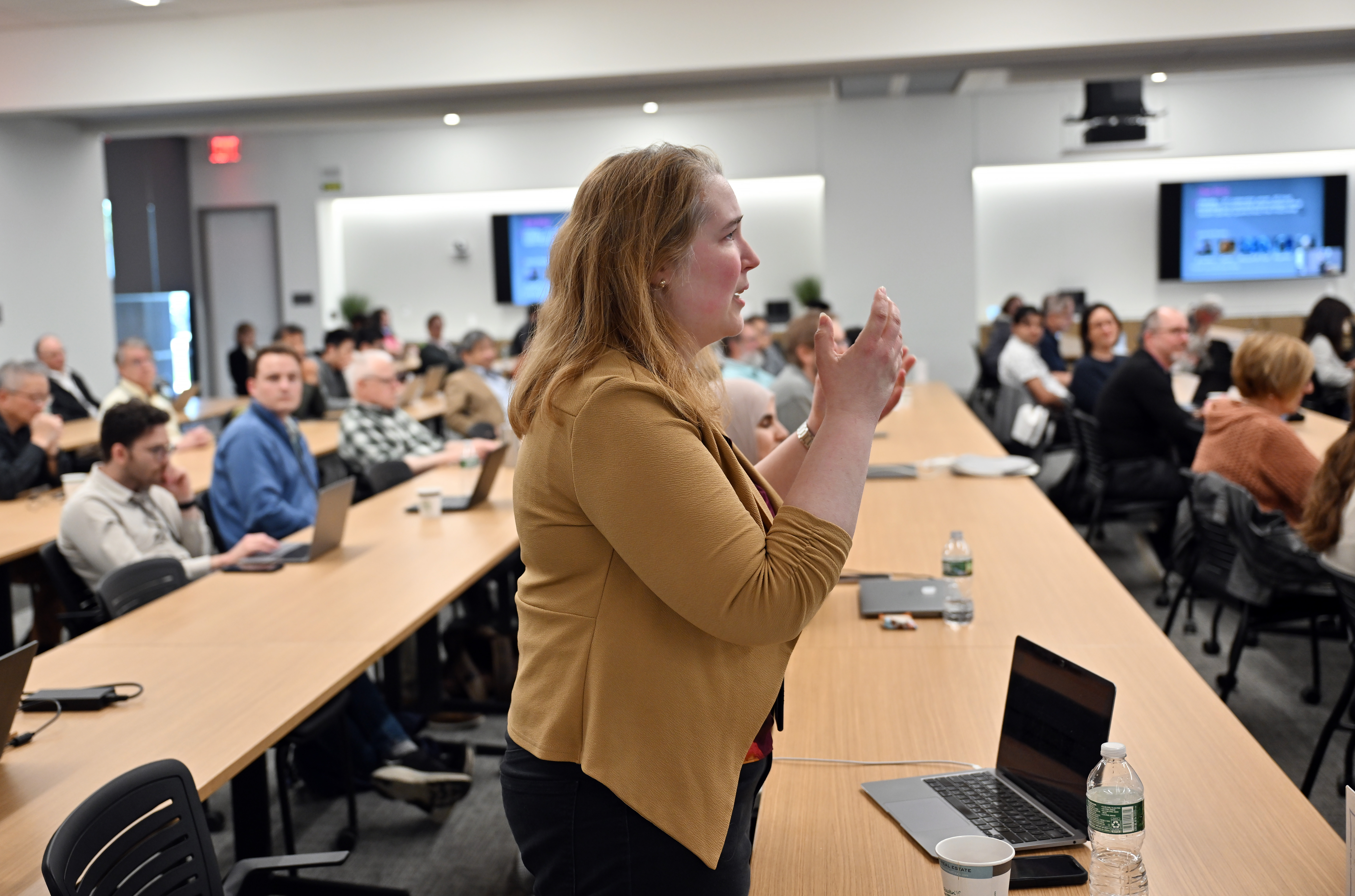
Megan Connors of Georgia State University and co-spokesperson for sPHENIX expressed gratitude to Relativistic Heavy Ion Collider operations staff and everyone in Brookhaven Lab's Collider-Accelerator Department who pulled out all the stops to overcome challenges and deliver the collisions the experiments needed. (Kevin Coughlin/Brookhaven National Laboratory)
“I just want to thank you and congratulate you for pulling all of this off,” sPHENIX co-spokesperson Megan Connors of Georgia State University told Shrey at the end of his report. “I think this talk was a fantastic description of the challenges that everyone faced the past three years to try to make this program happen. Major kudos to you and everyone at C-AD and other people behind the scenes doing all these things to make that possible.”
Following the run reports, attendees also heard updates on physics findings from the STAR, sPHENIX, and PHENIX collaborations. All experiments reported new details characterizing properties of the QGP, including its temperature and interactions with energetic jets, as well as how the system evolves as it transitions from a hot primordial soup into composite particles known as hadrons — including protons and neutrons — composed of tightly bound quarks and gluons. Continuing analyses of results from all three detectors and vast new datasets collected by STAR and sPHENIX will help address the key questions that remain.
EIC: ePIC and future physics
 enlarge
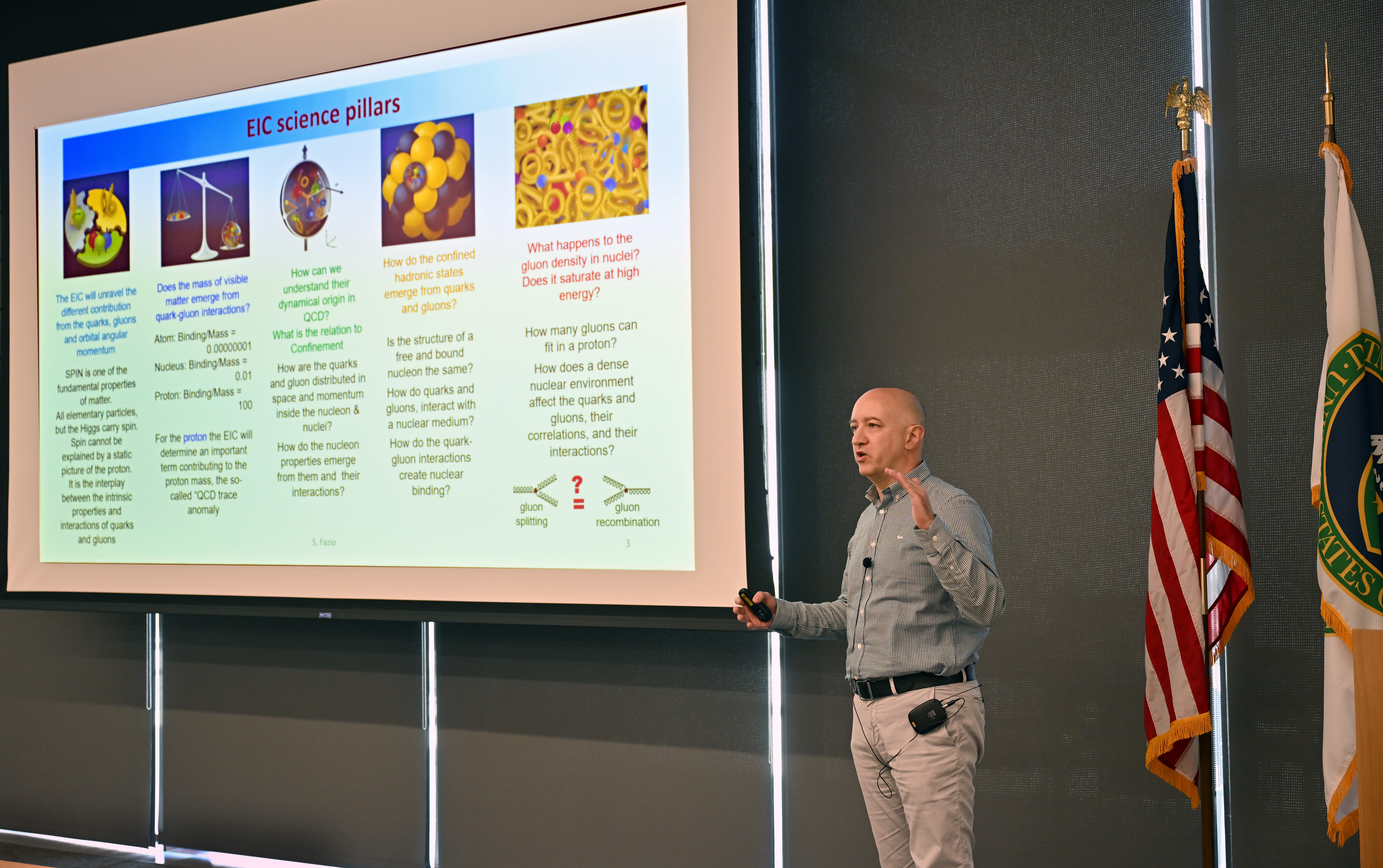
Salvatore Fazio of the University of Calabria highlighted the science goals of the Electron-Ion Collider. (Kevin Coughlin/Brookhaven National Laboratory)
Extending the view farther into the future, Salvatore Fazio of the University of Calabria gave an overview of the major science goals for the EIC, which is being built at Brookhaven in partnership with DOE’s Thomas Jefferson National Accelerator Facility. At the EIC, electrons will act as precision probes of the arrangement, motion, and interactions among quarks and gluons within protons and atomic nuclei. Scientists will use data from EIC collisions to elucidate how the quark and gluon “building blocks” lead to properties such as mass and spin and generate the force that holds the visible matter in our universe together.
“The EIC provides an unprecedented opportunity for the ultimate understanding of QCD,” Fazio said.
 enlarge
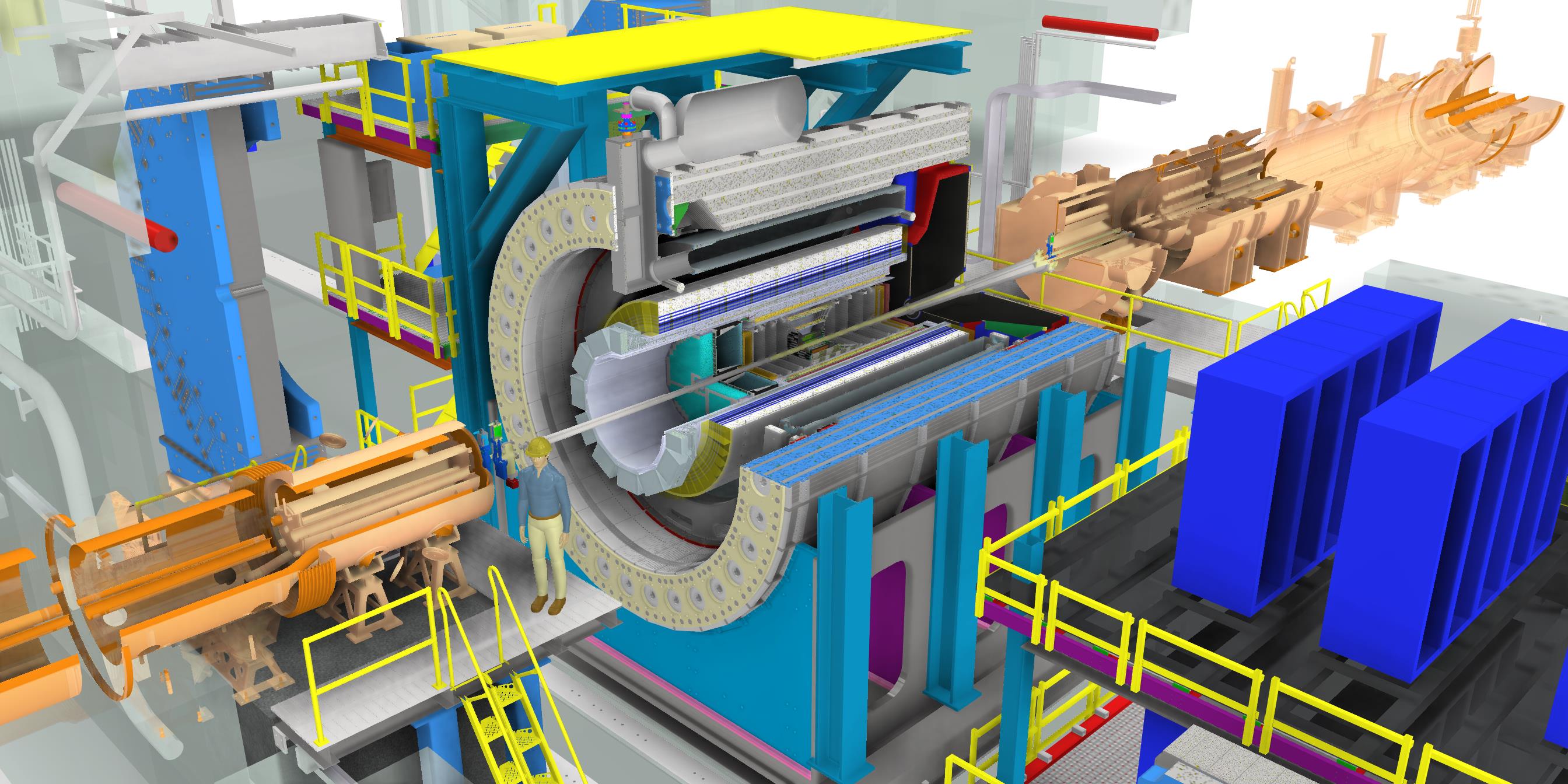
The many components of the Electron-Ion Collider's ePIC detector will operate in streaming readout mode, capturing all particles produced in electron-ion interactions to gain a comprehensive picture of each collision event. (The ePIC Collaboration)
He emphasized how the EIC science program will benefit from the accelerator’s groundbreaking capabilities — namely its ability to polarize both beams, achieve high collision rates over a wide range of energies, and collide electrons with a wide variety of nuclei. He also laid out the plan for ePIC, a state-of-the-art detector with many complex systems for tracking and identifying particles and a data acquisition system designed with AI from the start. Embedded AI will allow detector components to operate in triggerless, streaming readout mode — meaning they will capture all particles produced in interactions, including the remnants of the original scattered electron and ion, to gain a comprehensive picture of each collision event.
 enlarge
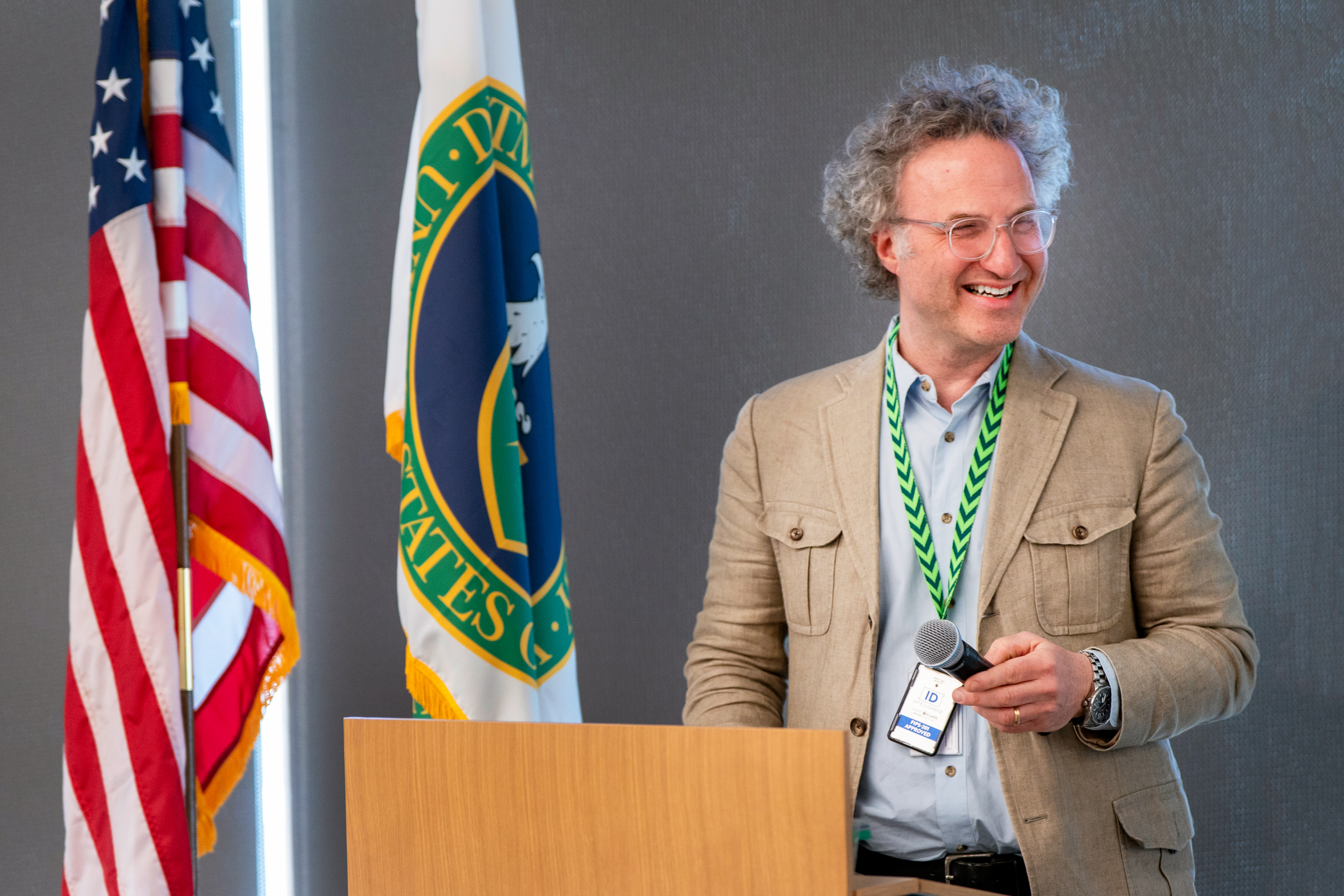
Peter Steinberg is the outgoing RHIC/AGS Users' Executive Committee chair. (David Rahner/Brookhaven National Laboratory)
Both AI and EIC science were addressed in focused workshops preceding the main meeting, along with detailed RHIC science discussions on baryon junction stopping, fixed target experiments, ultra-peripheral collisions, and jets and hard probes. There was also a focused workshop on research at the NASA Space Radiation Laboratory, which uses the first stages of the same accelerator chain that feeds beams to RHIC — and the future EIC.
Finally, following the main meeting, the theme of looking back and forward continued with a two-day symposium focused on celebrating the legacy of RHIC, the science still to come from its data, and the future at the EIC. “This was an unusual year for the annual Users’ Meeting, needing a whole week to celebrate both the final year of the RHIC program but also the generational story of the RHIC machine itself — and especially the lasting contributions of RHIC science to our understanding of nature and the universe,” said Peter Steinberg, chair of the UEC. “Attendees, many of whom were not even born when RHIC began, left energized by the sense of being part of a long, illustrious story — and with many chapters still to be written.”
Awards
Each year, the users’ community celebrates Ph.D. students and scientists recognized by the Users’ Executive Committee for outstanding thesis and research in either theory or experiment related to RHIC, AGS, the NASA Space Radiation Laboratory, the Tandem Van de Graaff, the Brookhaven Linac Isotope Producer, and/or EIC facilities. View the results of the merit awards, thesis awards, and Sambamurti Memorial Lectureship Competition.
In addition, Cheng-Wei Shih from National Central University received the best poster award for research: “Measurement of Charged Hadron Multiplicity in Au+Au Collisions at = 200 GeV with the sPHENIX Detector.”
Brookhaven National Laboratory is supported by the Office of Science of the U.S. Department of Energy. The Office of Science is the single largest supporter of basic research in the physical sciences in the United States and is working to address some of the most pressing challenges of our time. For more information, visit science.energy.gov.
Follow @BrookhavenLab on social media. Find us on Instagram, LinkedIn, X, and Facebook.
2026-22983 | INT/EXT | Newsroom