RHIC and EIC: Celebrating Success and Looking to the Future
Science symposium commemorates quarter century of operations at the Relativistic Heavy Ion Collider (RHIC) and kicks off new era in nuclear physics with transition to the Electron-Ion Collider (EIC)
June 11, 2026
By Karen McNulty Walsh and Amber Aponte
 enlarge
Early career panelists discussed the Electron-Ion Collider during a science symposium recapping the history of the Relativistic Heavy Ion Collider (RHIC) and the future of nuclear physics during a two-day event following the annual RHIC & AGS Users' Meeting. Pictured right to left are Kong Tu, Gian Michele Innocenti, Yeonju Go, and Cameron Dean. (David Rahner/Brookhaven National Laboratory)
Immediately following the annual meeting of scientists who conduct research at the Relativistic Heavy Ion Collider (RHIC) and the Alternating Gradient Synchrotron (AGS), the U.S. Department of Energy’s (DOE) Brookhaven National Laboratory hosted a science symposium to commemorate the end of RHIC operations. The two-day event, held May 14 and 15, celebrated more than 25 years of discovery science at RHIC and kicked off the transition to the future Electron-Ion Collider (EIC).
 enlarge
Daniel Brandenburg, an Ohio State University physicist and chair-elect of the RHIC/AGS Users' Executive Committee. (David Rahner/Brookhaven National Laboratory)
Speakers presented the historical and theoretical context that inspired construction of RHIC, demonstrated how RHIC science changed the field of nuclear physics, and illustrated how the versatility, flexibility, and ever-improving capabilities of the accelerator and detectors — along with flexible leadership and strong DOE support — made the RHIC program such a smashing success. They also laid out plans for the future at the EIC, a new state-of-the-art facility that will explore a new frontier in nuclear physics — the inner microcosm of the particles that make up the visible matter of the universe.
“Organizing the RHIC science symposium was one of the greatest honors of my career so far,” said Daniel Brandenburg of Ohio State University and chair-elect of the RHIC/AGS Users’ Executive Committee. “Celebrating the legacy and community that made RHIC possible was the perfect launchpad for the start of the Electron-Ion Collider program, which will define the next era in nuclear physics.”
A look back
Highlights from day one included Shoji Nagamiya, an early spokesperson for RHIC’s PHENIX experiment, memorializing Nobel Laureate T.D. Lee by retracing RHIC’s roots to Lee’s theoretical predictions about the behavior of quark matter under extreme conditions. He also recounted how Lee sparked support from Japan’s RIKEN laboratory for RHIC’s PHENIX experiment, the exploration of proton spin, and the formation of the RIKEN-BNL Research Center.
 enlarge
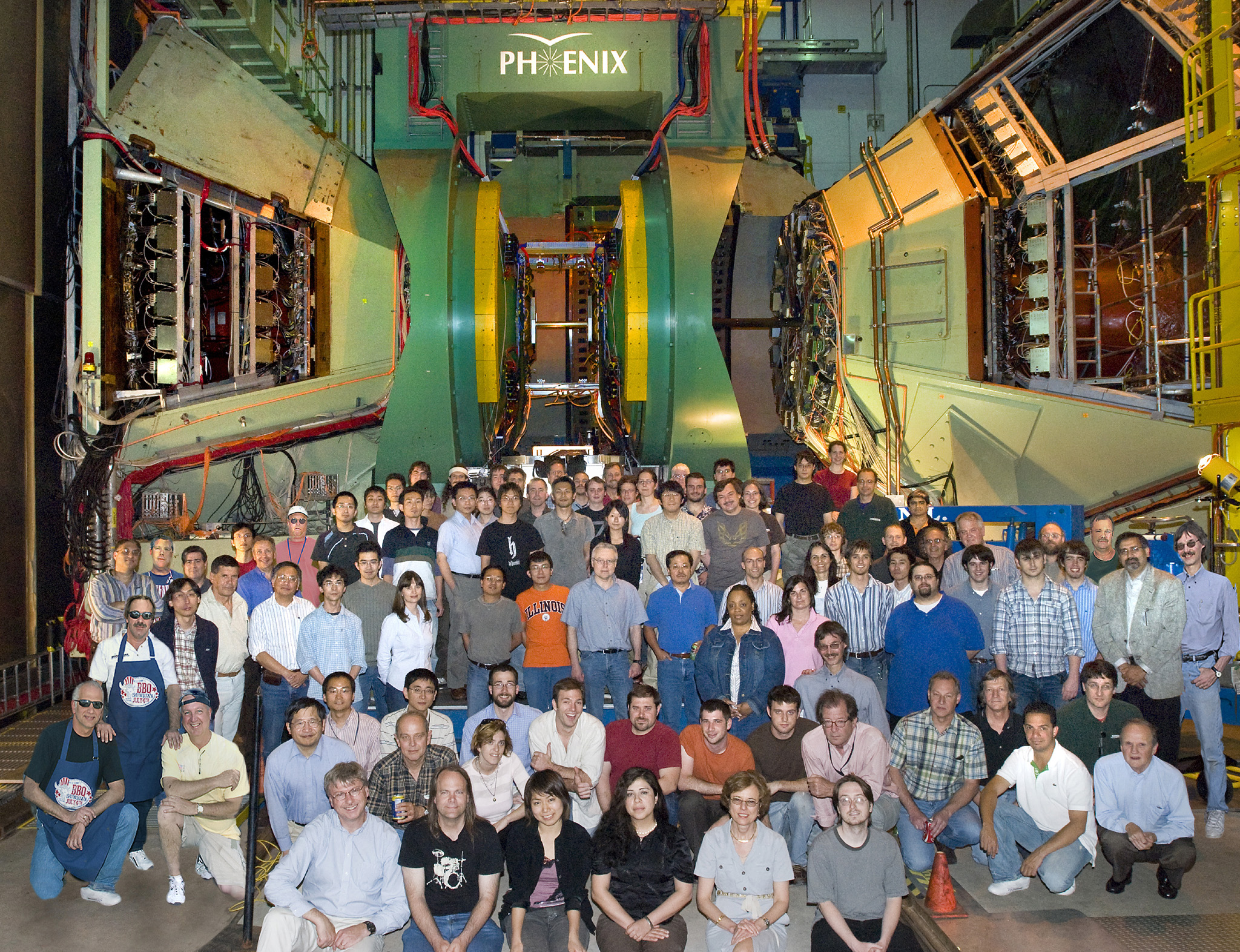
The PHENIX Collaboration is pictured with their detector circa 2007. PHENIX was formed from the merger of three Relativistic Heavy Ion Collider detector proposals that were initially rejected, with financial support from Japan's RIKEN laboratory, which also added capabilities for studying proton spin. (Brookhaven National Laboratory)
Axel Drees of Stony Brook University gave an overview of pre-RHIC searches for extreme forms of quark matter at the AGS and the Super Proton Synchrotron at CERN, the European Organization for Nuclear Research. He described measurements underlying CERN’s bold claim of a new state of matter — announced in 2000, just before RHIC turned on — which were soon followed by a “firework” of results from RHIC’s first collisions. These included qualitatively new measurements that would go on revolutionize physicists’ description and understanding of the quark-gluon plasma.
Perfect fluidity
 enlarge
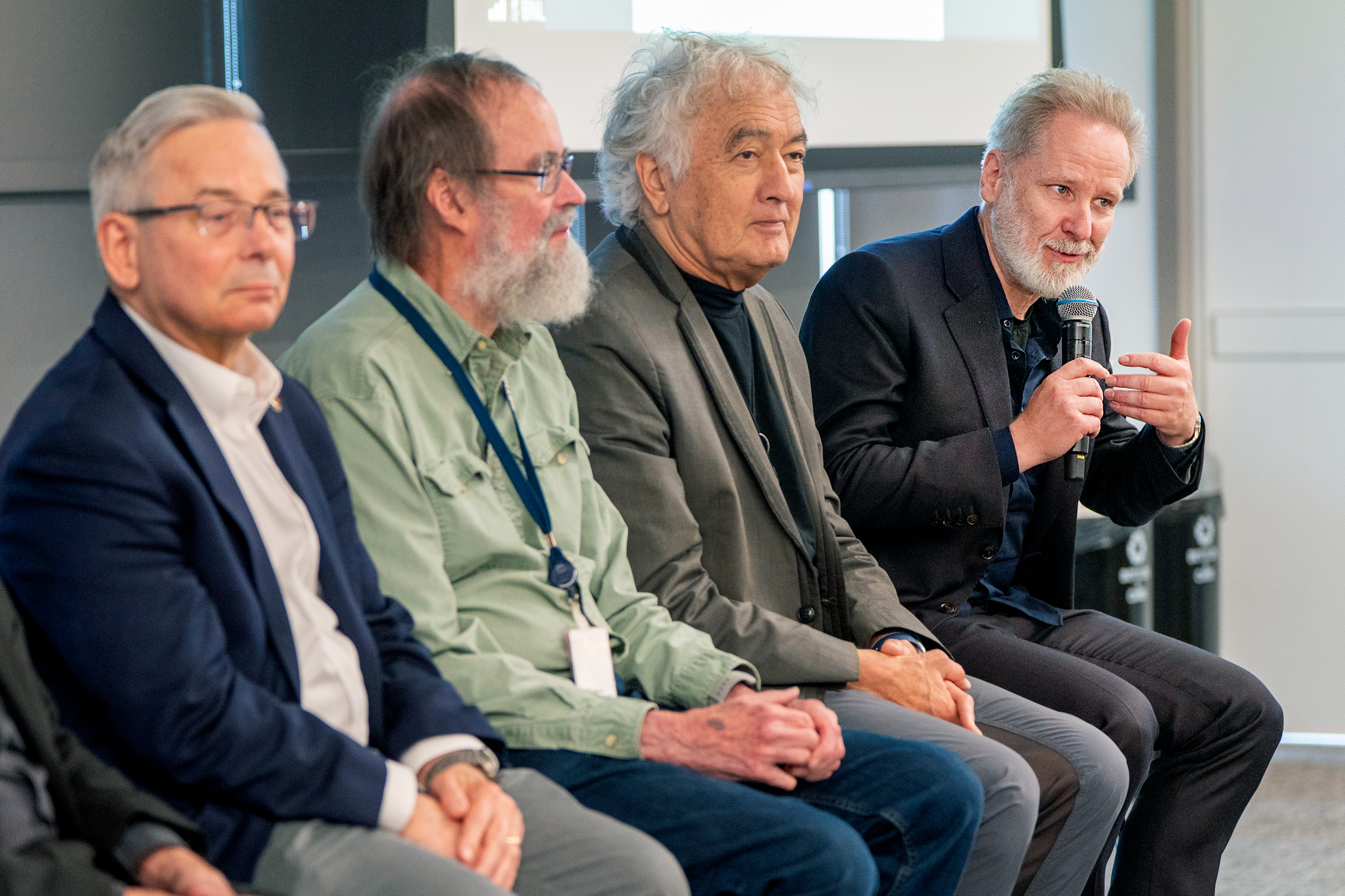
Representatives from the original four Relativistic Heavy Ion Collider experiments were present at the Relativistic Heavy Ion Collider science symposium. Pictured from left to right are Bill Zajc, Columbia University, PHENIX; Flemming Videbaek, Brookhaven Lab, BRAHMS; John Harris, Yale University, STAR; Gunther Roland, MIT, PHOBOS. (David Rahner/Brookhaven National Laboratory)
Speakers representing the initial RHIC experiments — STAR, PHENIX, PHOBOS, and BRAHMS — briefly recalled the details of each detector’s “birth,” stand-out capabilities, and contributions to RHIC’s major results. A central theme: How multiple detectors with distinct strengths could test and cross-check data from complementary vantage points. Highlights included measurements of gluons’ contribution to proton spin and the carefully coordinated, peer-reviewed white papers from all four experimental collaborations announcing the discovery of the “perfect liquid,” as well as later revelations about its temperature.
Nobel Laureate David Gross of the University of California, Santa Barbara, noted in his keynote “farewell to an amazing facility,” how radical the perfect liquid idea was, describing the expectation at the time that a quark-gluon plasma would be a weakly interacting gas of quarks and gluons.
“The remarkable thing is that this is not what was discovered,” he said. “It was not a weakly interacting gas, but what is interpreted now as a strongly interacting liquid — a remarkable liquid — the most perfect we’ve ever observed experimentally with viscosity almost as small as it could be.” He described how the discovery sparked widespread ongoing interest — including at CERN’s Large Hadron Collider (LHC) — and connections to condensed matter physics, string theory, and more.
 enlarge
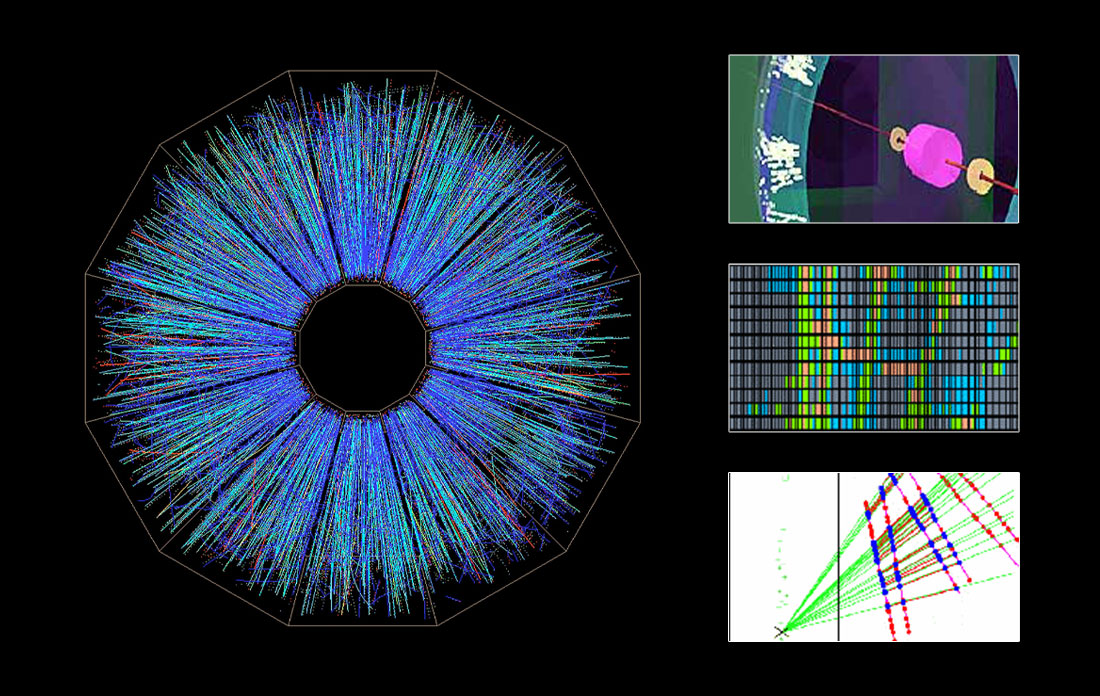
Images showing the tracks of thousands of subatomic particles streaming from collisions at the Relativistic Heavy Ion Collider (RHIC) lit up display monitors at the STAR detector for the first time on June 12, 2000. All four RHIC detector were recording collisions by Friday, June 15 (insets top to bottom: PHENIX, BRAHMS, PHOBOS).
Magnificent machine
Thomas Roser, a former chair of Brookhaven’s Collider-Accelerator Department, highlighted the sustained innovations in accelerator technologies that made all these discoveries possible at RHIC. These included many “world-leading developments” in magnets and feedback systems for monitoring, cooling, and controlling beams that have vastly improved RHIC’s performance and ability to explore the properties of the quark-gluon plasma and proton spin. Yousef Makdisi and Jianwei Qiu further elaborated on RHIC’s unique ability to establish and maintain polarized proton beams and use them to uncover gluons’ contribution to spin and map out other characteristics of nuclear matter.
“The success of RHIC was critically dependent on the success of the accelerator,” said Abhay Deshpande, Brookhaven Lab’s associate laboratory director for Nuclear and Particle Physics. “We don’t get the chance to thank accelerator physicists enough. In the last few years, I personally felt the pressure on the run coordinators. Every time they produced what we needed, it was like having a genie saying, ‘your wish is my command.’”
 enlarge
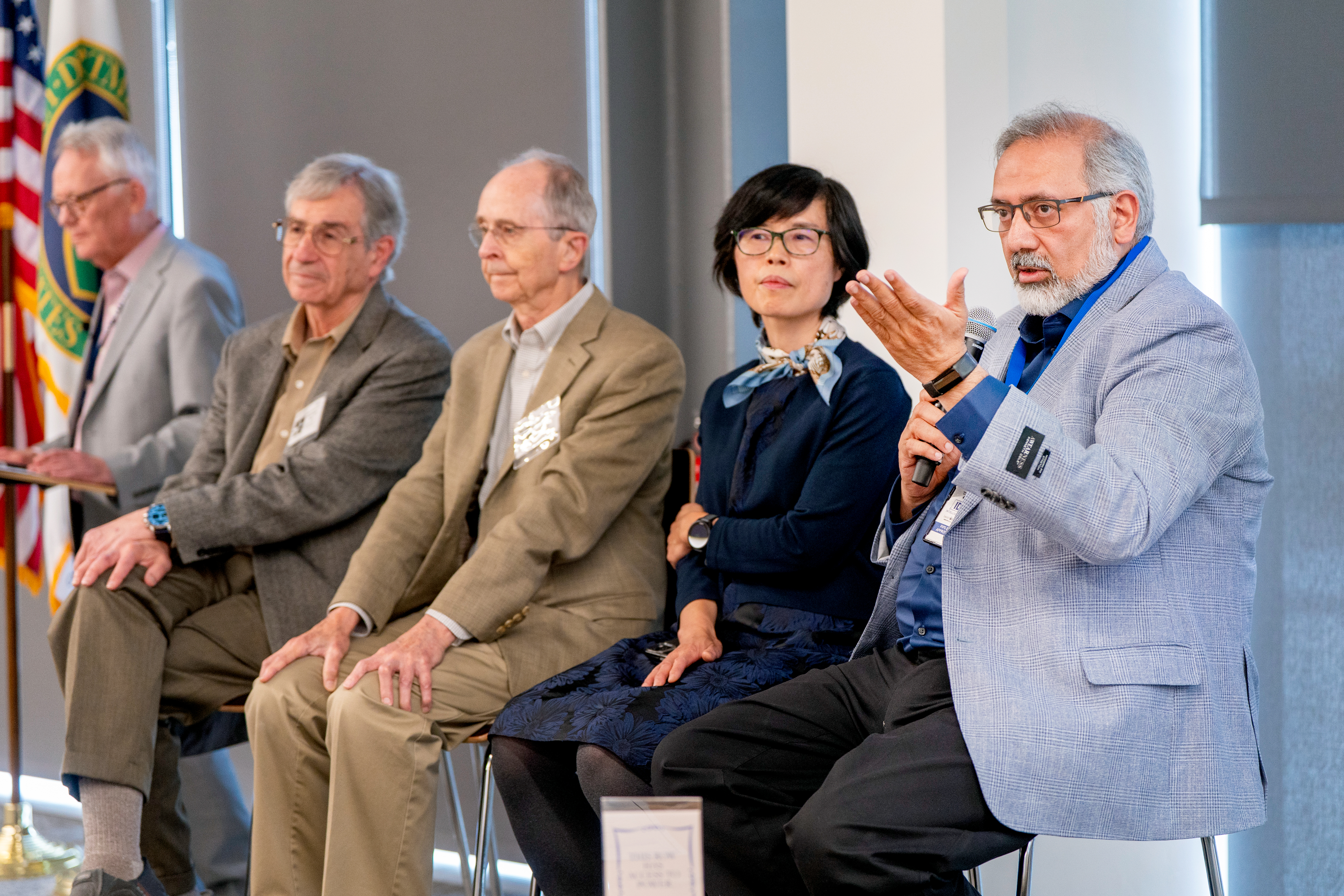
Former Brookhaven Lab Director Doon Gibbs, left, asked former and current associate laboratory directors for Nuclear and Particle Physics to share their biggest challenges, advice, and happiest moments. Pictured from left to right are Steve Vigdor, Berndt Mueller, Haiyan Gao, and Abhay Deshpande. (David Rahner/Brookhaven National Laboratory)
The first day concluded with a panel chaired by former Lab Director Doon Gibbs asking Deshpande and three former associate laboratory directors — Steve Vigdor, Berndt Mueller, and Haiyan Gao — to share their greatest challenges, advice for future program leaders, and happiest moments. Hurdles included shortfalls in funding, runs cut short due to technical issues, and supply chain interruptions that threatened the delivery of sPHENIX, RHIC’s newest experiment. But each associate laboratory director described the teamwork that overcame these obstacles and the satisfaction of delivering and sharing groundbreaking science.
 enlarge
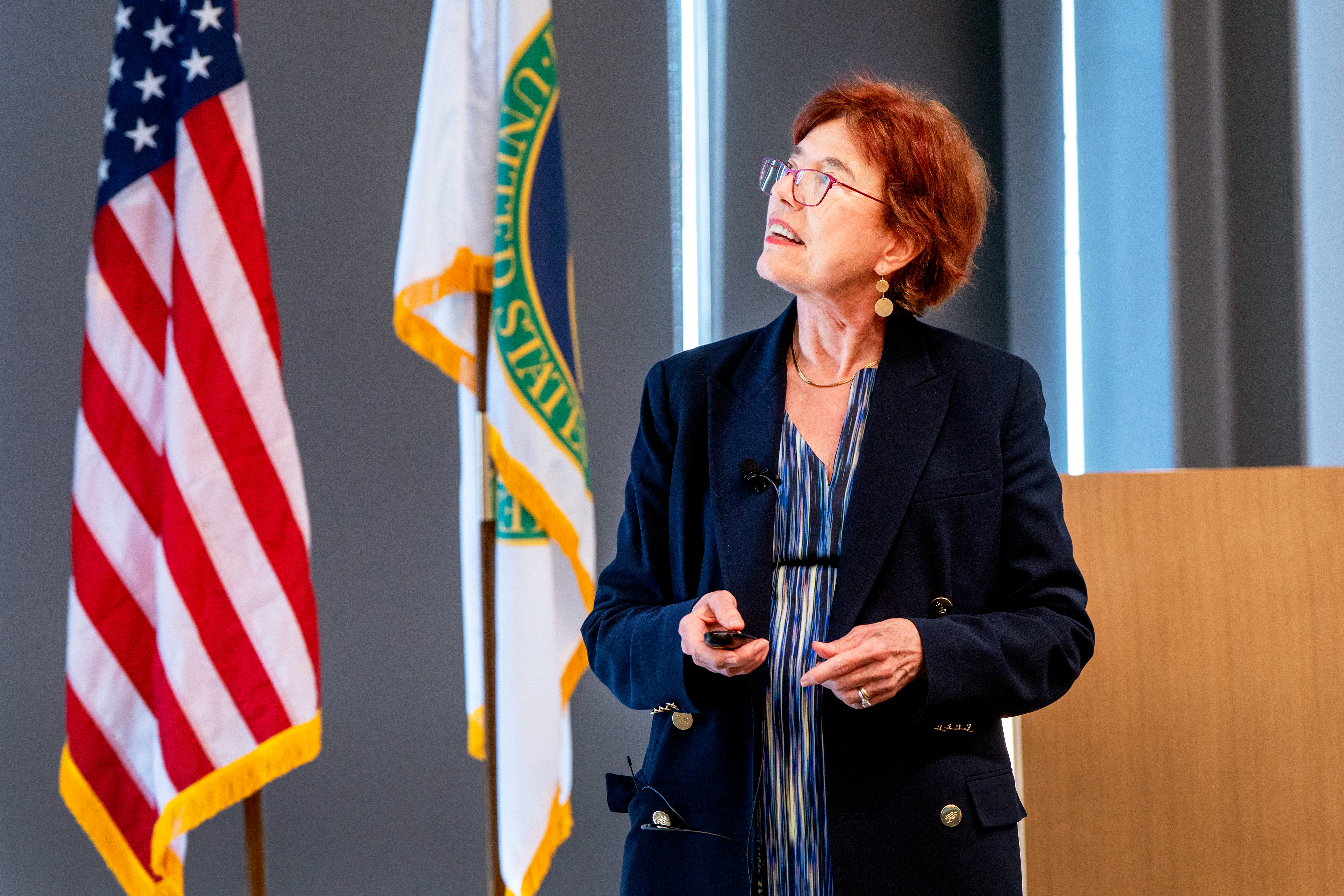
University of California, Berkeley, Distinguished Physicist Barbara Jacak delivered a BSA Distinguished Lecture recapping the Relativistic Heavy Ion Collider "little bangs" and their connection to the Big Bang at the beginning of the universe. (David Rahner/Brookhaven National Laboratory)
Finally, University of California, Berkeley, Distinguished Physicist Barbara Jacak, a former spokesperson for RHIC’s PHENIX experiment, gave a BSA Distinguished Lecture titled “Little Bangs at RHIC and the Big Bang at the Beginning.” Her central messages: “Uncovering nature’s secrets is not easy,” and “No matter what we know, we want to know more.”
Discoveries still to come
That quest for deeper understanding set the stage for day two of the symposium, which featured presentations on the enormous amount of RHIC data still to be analyzed — including the record-setting output of its final run — and discussions of how RHIC’s findings have seeded some of the key questions that will be explored at the EIC.
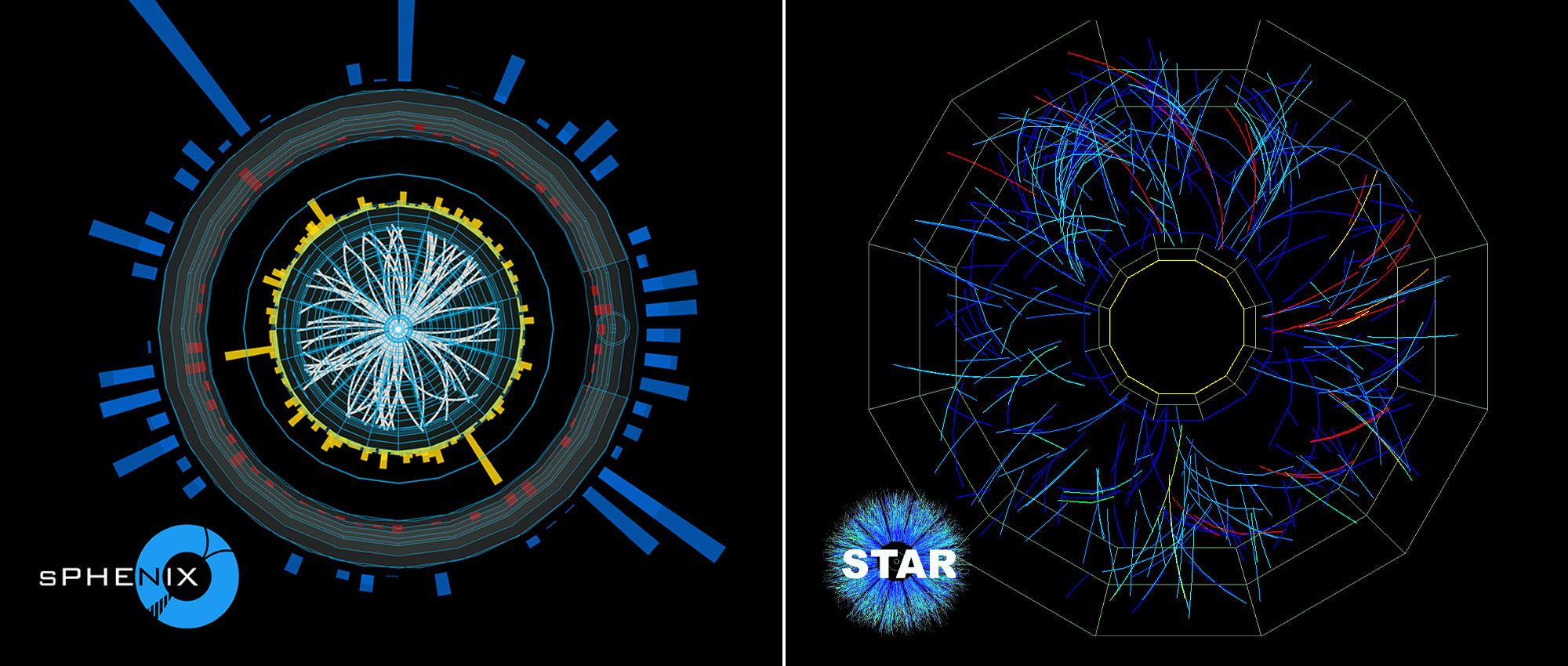
Brookhaven Lab physicist Dave Morrison, former co-spokesperson for the sPHENIX experiment, highlighted the challenging path and perseverance involved in establishing sPHENIX. Spokespersons from STAR, PHENIX, and sPHENIX then highlighted plans for future data analyses that will generate new discoveries over the next decade or more. There was also an emphasis on preserving RHIC data and developing shared analysis tools to enable comparisons with future results from new and existing facilities across the world, including the EIC.
 enlarge
Final collisions from the Relativistic Heavy Ion Collider's (RHIC) sPHENIX and STAR detectors represent a fraction of the data still to be analyzed, which is expected to generate new RHIC discoveries for another decade or more. (Brookhaven National Laboratory)
Massachusetts Institute of Technology (MIT) physicist Richard Milner traced the origins of the EIC, describing the collider as the culmination of decades of work to understand quantum chromodynamics, the theory that describes the interactions of quarks and gluons and the strong nuclear force. He highlighted the breakthroughs in proton spin, gluon saturation, and 3D nucleon structure that shaped the EIC science case, while predicting, “There will be surprises.”
 enlarge
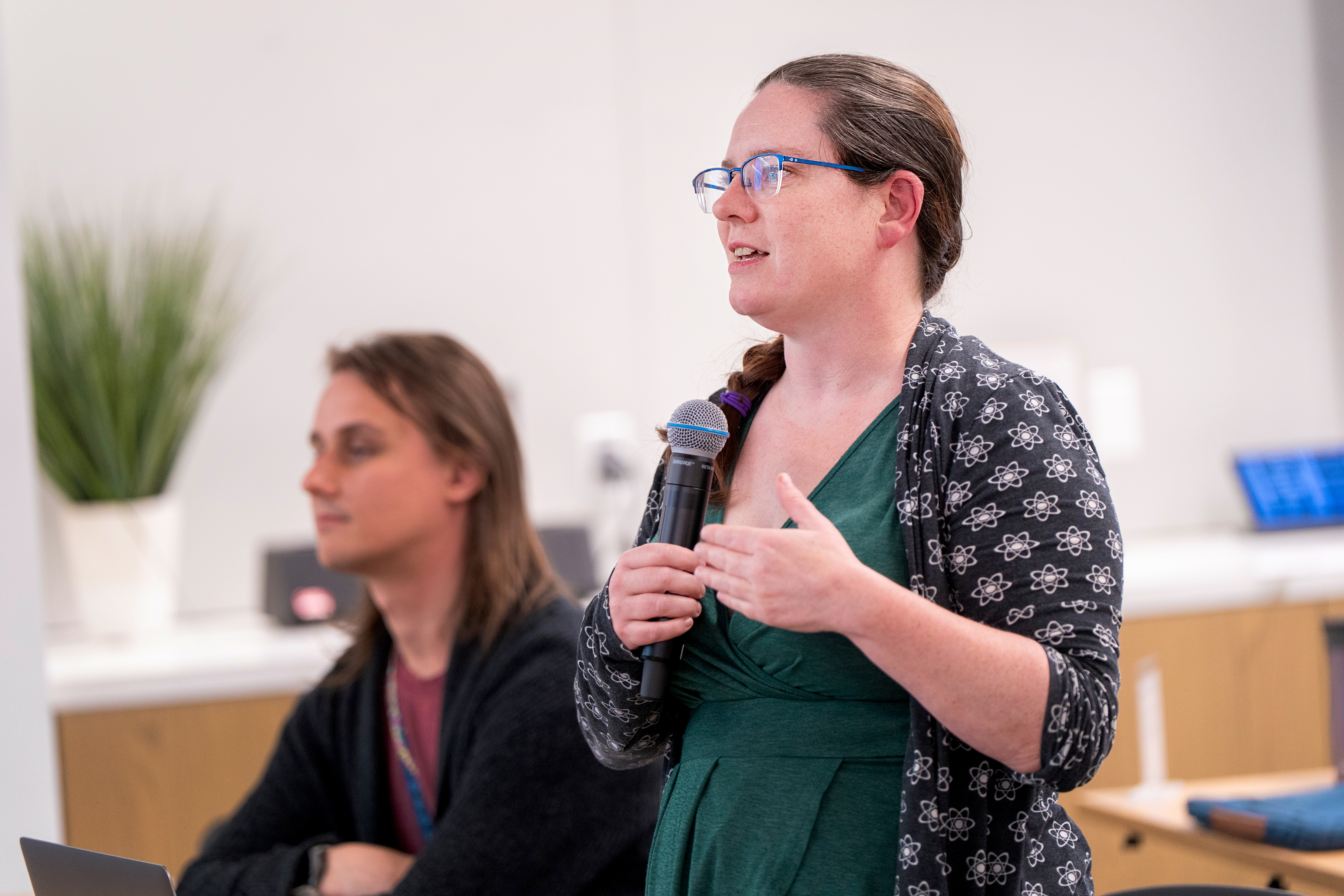
Rosi Reed of Lehigh University spoke at the Relativistic Heavy Ion Collider science symposium. (David Rahner/Brookhaven National Laboratory)
Expanding on that scientific foundation, Lehigh University physicist Rosi Reed described how the EIC will seek answers to questions about the fundamental building blocks of matter, informed by RHIC’s results, and how new information revealed by the EIC might also provide deeper insight into the discoveries at RHIC.
To further understand detailed aspects of the quark-gluon plasma, “We need to understand initial conditions,” Reed said, referring to the characteristics of nuclei before they collide at RHIC. She emphasized how precision EIC measurements of gluons and nuclear fluctuations could sharpen heavy-ion studies.
America’s next collider
Turning from scientific vision to technical realization, Sergei Nagaitsev, the EIC’s technical director, detailed the engineering and accelerator technologies required to transform RHIC into the EIC. He explained how polarized beams, advanced cooling systems, superconducting radiofrequency cavities, and precision magnet designs will achieve high collision rates for electrons with a broad range of ion species over a wide span of collision energies. He described the machine as “super exciting for accelerator scientists and engineers,” noting that its complexity and ambitious performance goals push beyond previous collider designs.
“If we knew everything up front, we wouldn’t be doing this,” Nagaitsev said, expressing confidence that the accelerator community will solve the challenges required to bring the EIC online.
Technological advances are also shaping the detector systems that will carry out the EIC science mission, explained physicist John Lajoie of DOE’s Oak Ridge National Laboratory, who is the spokesperson for ePIC, the flagship detector planned for the EIC. Drawing on experiences from PHENIX, spin physics, and forward detector upgrades, Lajoie showed how technologies and concepts from STAR, sPHENIX, and earlier EIC detector proposals evolved into today’s highly integrated ePIC design.
 enlarge
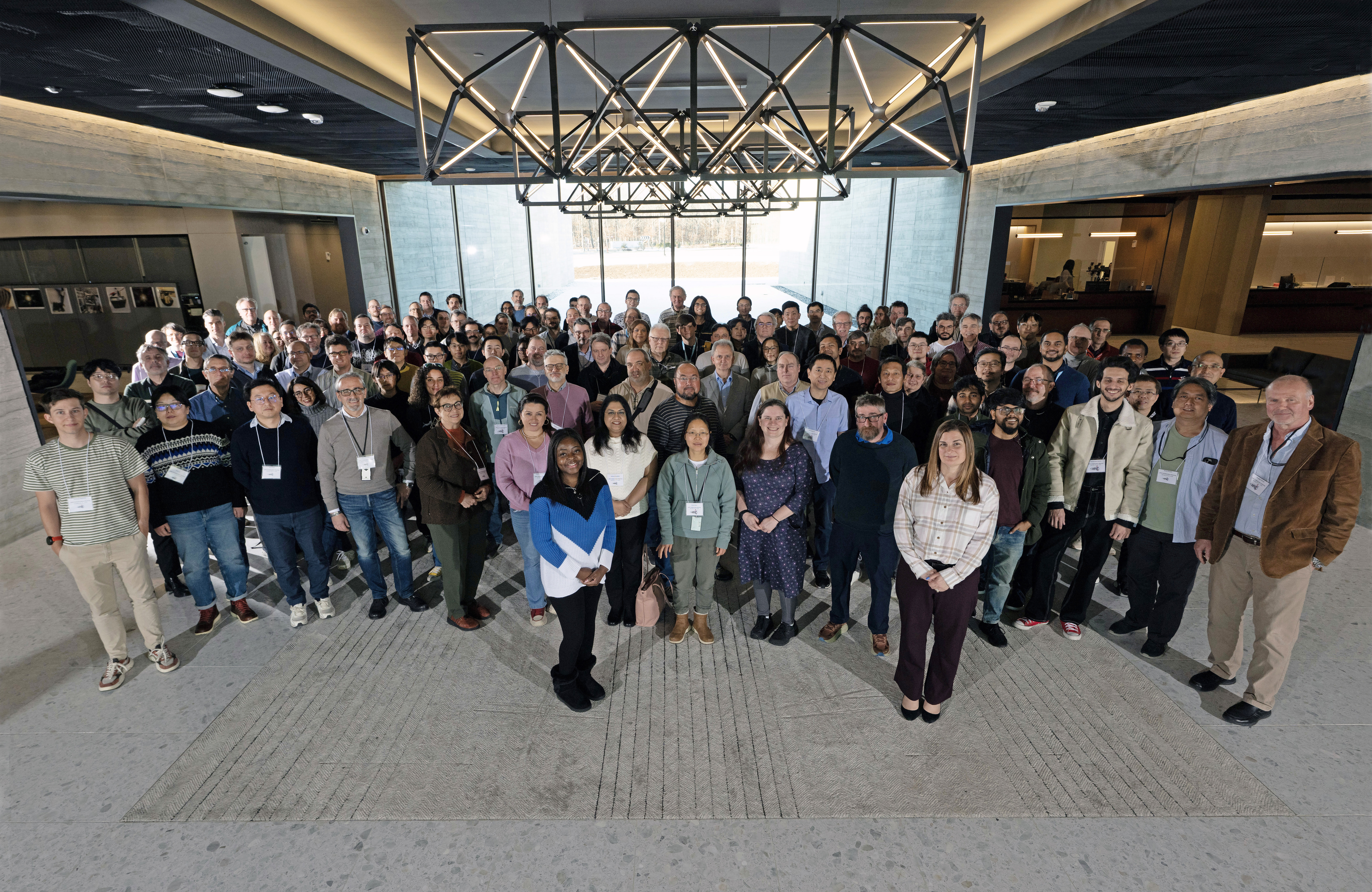
Members of the Electron-Ion Collider's ePIC Collaboration posed for a group photo at their meeting at Brookhaven National Laboratory in January 2026. (Kevin Coughlin/Brookhaven National Laboratory)
Honoring and learning from legacy
One highlight of the day was a moving tribute to former Lab Director and PHENIX project head Sam Aronson — who passed away in March 2026 — by Columbia University physicist and former PHENIX spokesperson Bill Zajc, former Director Gibbs, and others. They highlighted Aronson’s central role during RHIC’s 2005 “perfect liquid” discovery and other major scientific achievements, and his role as an exceptional mentor and manager who guided teams through technical and organizational challenges.
Brookhaven Lab nuclear theorist Raju Venugopalan delivered another memorial talk honoring physicist James Daniel “BJ” Bjorken as one of the foundational figures of modern particle physics whose ideas shaped both RHIC and the future EIC. Venugopalan emphasized Bjorken’s humility and enduring enthusiasm for discovery, concluding with one of his honoree’s favorite sentiments: “Why do we do physics? Because physics is fun!”
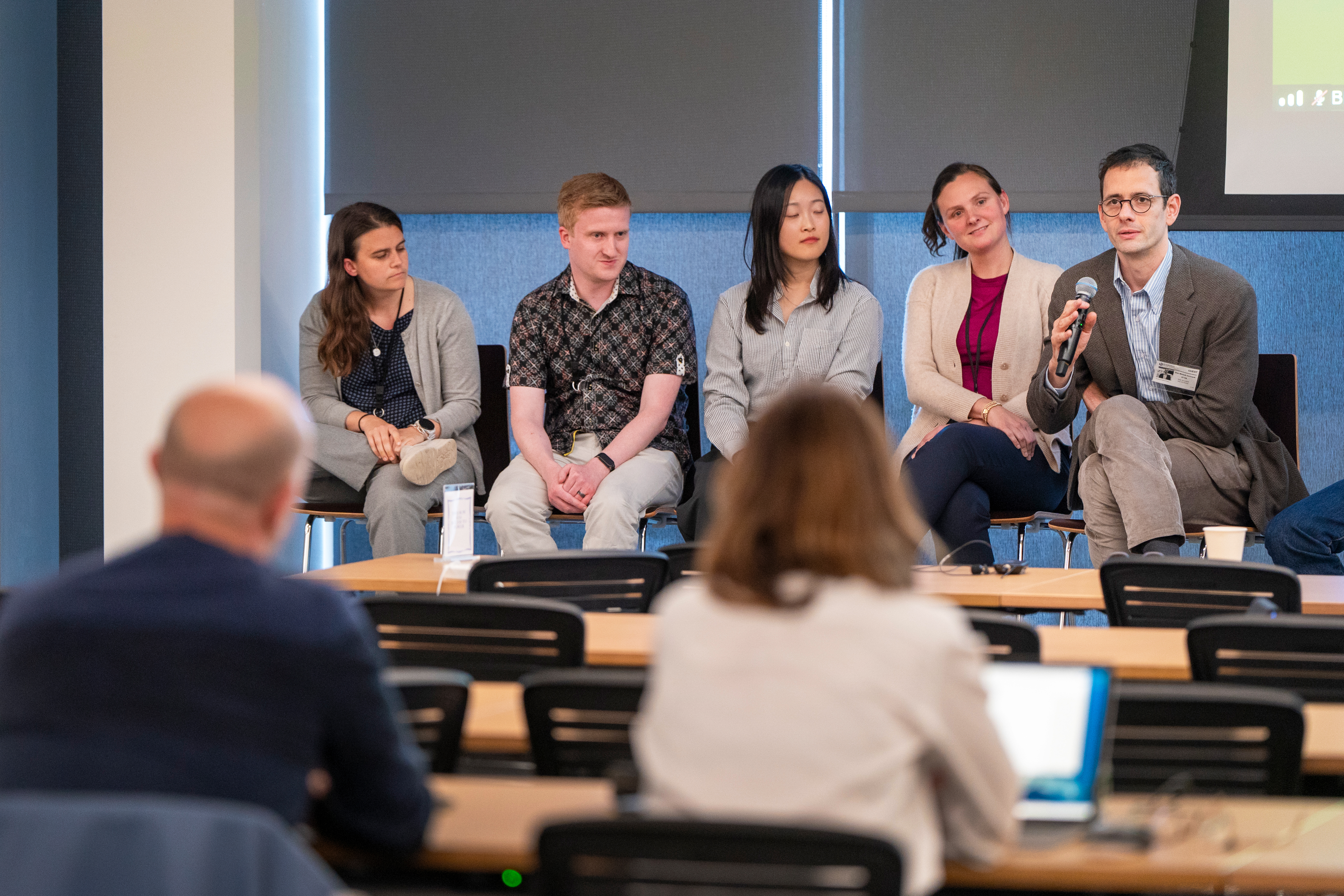
A panel of early career scientists representing the future workforce of the EIC picked up on that spirit of optimism. They reflected on the mentorship, collaboration, and hands-on experience they gained through RHIC, sPHENIX, STAR, and the LHC.
“I hope that we live up to the legacy that the leaders of the previous generation left,” said Hannah Bossi of MIT.
 enlarge
Early career panelists at the Relativistic Heavy Ion Collider science symposium included Hannah Bossi (MIT), Cameron Dean (Iowa State as of August 2026), Yeonju Go (Goldhaber Fellow at Brookhaven Lab), Laura Havener (Yale), and Gian Michele Innocenti (MIT). (David Rahner/Brookhaven National Laboratory)
For EIC scientists eager to make use of the new facility but perhaps concerned about which capabilities may or may not be present at the start of the science program, the symposium emphasized the importance of resilience and perseverance.
Many speakers mentioned challenges RHIC faced and overcame — including more than one existential threat to funding, the COVID-19 pandemic, and technological glitches caused by heatwaves, blizzards, bees, and more. Even at the beginning, only STAR was selected from among four original RHIC detector proposals; PHENIX formed later from a merger of the other three. Some of the collider’s critical performance parameters had not been demonstrated when construction began. And collision rates and energies were, at first, well below RHIC’s design range.
“But we still had a compelling science plan,” Deshpande said. In terms of difficult choices facing the EIC today, he said, “We need to learn from that example. Though not everything we wanted was there on the first day, we moved forward with science that was unique and built upon it over time. Eventually we exceeded all expectations — by far. We expect the same to happen at the EIC.”
Brookhaven National Laboratory is supported by the Office of Science of the U.S. Department of Energy. The Office of Science is the single largest supporter of basic research in the physical sciences in the United States and is working to address some of the most pressing challenges of our time. For more information, visit science.energy.gov.
Follow @BrookhavenLab on social media. Find us on Instagram, LinkedIn, X, and Facebook.
2026-22984 | INT/EXT | Newsroom