


- Home
-
Groundwater Protection
-
Groundwater Protection
Program Overview
Documents and Reports
Groundwater Projects
Surface Projects
Land Use & Institutional Controls Mapping
Groundwater Status Reports
Contact
Reactor Decommissioning Projects
About
BGRR Science & Accomplishments
Celebrating DOE's Cleanup Accomplishments (PDF)
ContactBrookhaven Graphite Research Reactor (BGRR)
Brookhaven Graphite Research Reactor(BGRR) Overview
BGRR Complex Description
Decommissioning Decision
BGRR Complex Cleanup Actions
BGRR Documents
High Flux Beam Reactor (HFBR)
High Flux Beam Reactor (HFBR) Overview
HFBR Complex Description
Decommissioning Decision
HFBR Complex Cleanup Actions
HFBR Documents
-
Birds
A total of well over 200 species of birds have been identified at Brookhaven Lab since 1948; at least 85 species are known to nest on site. Some of these nesting birds have shown declines in their populations nationwide over the past 30 years. The Laboratory conducts routine monitoring of songbirds along seven permanent bird survey routes in various habitats on site.
A total of 139 bird species have been identified in surveys since the year 2000. Variations in the number and species identified during each survey may reflect the time of observation, variations in weather patterns between years, and possible changes in the environment.
The eastern bluebird (Sialia sialis) has been identified as a declining species of migratory birds in North America. This is due to loss of habitat and nest site competition from European starlings (Sturnus vulgaris) and house sparrows (Passer domesticus). Brookhaven’s Natural Resource Management program includes habitat enhancement for the eastern bluebird. Since 2000, the Laboratory has installed and maintained nest boxes around open grassland areas and the Long Island Solar Farm to enhance their population.
Migratory birds occasionally cause safety and health concerns, particularly Canada geese (Branta canadensis) and several species of migratory birds that occasionally nest on buildings or in construction areas on site. Over the past several years, the resident Canada goose population at BNL began increasing, with the potential to reach large enough numbers that could result in health and safety issues. In 2007, under a permit from the U.S. Fish & Wildlife Service, the Laboratory began managing the resident goose population by oiling their eggs which prevents them from hatching. We have had some success limiting the growth of the goose population using this method, however, the population increased significantly in 2020-2021 and calls for management increased. In response, a cull was conducted in 2021, removing 80 geese from the site, and 40 pounds of meat was donated to a local food pantry.
Other methods to reduce on-site goose populations include the use of dogs as deterrents. In 2025 a local company was contracting to have their specially-trained dogs chase the geese out of the area and condition them to think that the site is not safe. The resident population has clearly been reduced as a result of these efforts, however, over time the geese will return so this must be done regularly.
Birds NY State Threatened, Endangered, of Special Concern, or of Greatest Conservation Need (nesting, transient, or potentially present)
| Common Name | Scientific Name | Status |
|---|---|---|
| American kestrel | Falco sparverius | SGCN |
| American woodcock | Scolopax minor | SGCN |
| Black-billed cuckoo | Coccyzus erythropthalmus | SGCN |
| Black-crowned night heron | Nycticorax nycticorax | SGCN |
| Blue-winged warbler | Vermivora cyanoptera | SGCN |
| Brown thrasher | Toxostoma rufum | SGCN |
| Common Nighthawk | Chordeiles minor | SGCN |
| Cooper's hawk | Accipiter cooperii | SC |
| Glossy ibis | Plegadis falcinellus | SGCN |
| Great egret | Ardea alba | SGCN |
| Greater yellowlegs | Tringa melanoleuca | SGCN |
| Northern Bobwhite | Colinus virginianus | SGCN |
| Osprey | Circus cyaneus | T |
| Northern harrier | Pandion haliaetus | SC |
| Prairie warbler | Dendroica discolor | SGCN |
| Red-headed woodpecker | Melanerpes erythrocephalus | SC |
| Scarlet tanager | Piranga olivacea | SGCN |
| Sharp-shinned hawk | Accipiter striatus | SC |
| Whip-poor-will | Caprimulgus vociferus | SC |
| Wood thrush | Hylocichla mustelina | SGCN |
| Worm-eating warbler | Helmitheros vermivorum | SGCN |
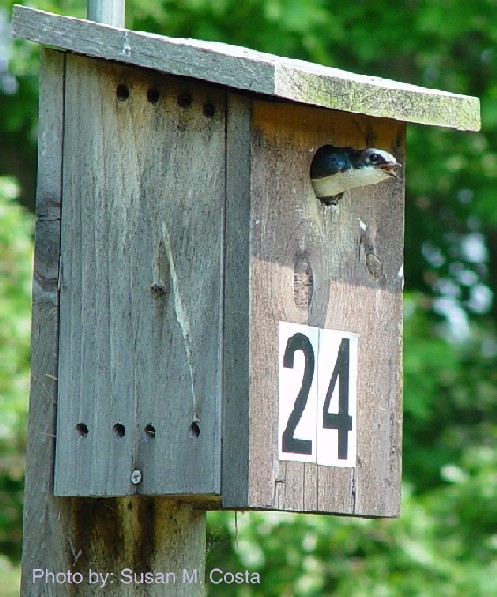
Bluebird boxes are also used by other birds like this Tree Swallow.
Sitewide bird observations conducted in May, June, August, and September of 1994 at BNL were used to calculate habitat-specific diversity and to compare diversity and species richness between habitats. The results of each 1000-ft and 5000-ft upland transect were pooled, the results of the six 1000-ft wetland transacts were pooled; and the results from upland transacts were discarded as no spring (May) observations were made because this habitat was added after the May survey.
Nest Box Use by Other Species
Bluebird boxes are used by several other species of birds including tree swallows (see photo), house wren, black-capped chickadee, and house sparrows. The size of the entry hole limits the use to birds that are of similar size compared to bluebirds.
Nest Box Nesting Success
As mentioned above BNL has 46 boxes established around suitable habitat located on Lab property. Individual box use may be variable from year to year, but nesting success has been consistent over the past two years with 19 successful bluebird nests. The table below presents the nesting success for 2001 through 2004.
| Box # | 2001 | # of nests | 2002 | # of nests | 2003 | # of nests | 2004 | # of nests |
| 1 | Empty | Empty | House Wren | 1 | Few Grasses | |||
| 2 | Bluebird | 1 | Bluebird | 1 | Bluebird | 1 | Bluebird | 1 |
| 3 | Bluebird | 2 | Empty | House Wren | Few Grasses | |||
| 4 | Bluebird | 1 | Bluebird | 1 | House Wren | House Wren | 1 | |
| 4 | Bluebird | 1 | ||||||
| 5 | Bluebird | 1 | Bluebird | 1 | Bluebird | 1 | Bluebird | |
| 6 | House Wren | House Wren | 1 | House Wren | House Wren | |||
| 7 | Empty | 1 | House Wren | House Wren | House Wren | |||
| 8 | Bluebird | 1 | Bluebird | 2 | Empty | Bluebird | 1 | |
| 9 | Few Grasses | House Wren | Empty | House Wren | 1 | |||
| 10 | House Wren | Bluebird | 1 | Empty | Bluebird | 1 | ||
| 10 | House Wren | 1 | ||||||
| 11 | Bluebird | 1 | Bluebird | 1 | Empty | House Wren | ||
| 12 | Moss | Chickadee | 1 | Mushroom | Empty | |||
| 12A | Mushrooms | |||||||
| 13 | Empty | Empty | Empty | Empty | ||||
| 14 | House Wren | 1 | Chickadee | 1 | Empty | House Wren | ||
| 14 | Bluebird | 1 | ||||||
| 15 | House Wren | 1 | House Wren | 1 | House Wren | Few Grasses | ||
| 16 | House Wren | 1 | House Wren | Bluebird | 1 | Bluebird | 1 | |
| 16 | Bluebird | 1 | House Wren | 1 | ||||
| 17 | Empty | Bluebird | 1 | House Wren | House Wren | |||
| 18 | Empty | Wasps | Empty | Bluebird | 1 | |||
| 19 | Empty | Tree Swallow | 1 | Bluebird | 1 | Empty | ||
| 20 | Empty | Bluebird | 1 | House Wren | Twigs | |||
| 21 | House Wren | 1 | Tree Swallow | 1 | House Wren | Bluebird | 2 | |
| 21 | Bluebird | 1 | ||||||
| 22 | House Wren | House Wren | House Wren | 2 | New Box | |||
| 22 | Bluebird | 1 | ||||||
| 23 | Bluebird | 2 | Bluebird | 1 | Missing Box | Bluebird | 1 | |
| 24 | House Wren | 1 | Bluebird | 2 | Tree Swallow | 1 | Tree Swallow | 1 |
| 24 | Bluebird | 1 | Bluebird | 1 | Tree Swallow | 1 | ||
| 25 | House Wren | 1 | Tree Swallow | 1 | Tree Swallow | 1 | Tree Swallow | 1 |
| 25 | Bluebird | 1 | Bluebird | 1 | Bluebird | 2 | ||
| 26 | House Wren | Empty | Bluebird | 1 | Tree Swallow | 1 | ||
| 27 | Few Grasses | House Wren | 1 | Tufted Titmouse | 1 | House Wren | 1 | |
| 28 | Empty | Wasps | Wasps | Yellow Jackets | ||||
| 29 | Empty | House Wren | 1 | Bluebird | 1 | Tree Swallow | 1 | |
| 30 | Bluebird | 1 | Tree Swallow | 1 | Bluebird | 1 | Bluebird | 2 |
| 31 | Bluebird | 1 | Empty | Empty | House Wren | 1 | ||
| 32 | Bluebird | 1 | Bluebird | 2 | Bluebird | 2 | Bluebird | 2 |
| 32 | Tree Swallow | 1 | Empty | |||||
| 33 | Bluebird | 1 | Bluebird | 1 | Tree Swallow | 1 | House Wren | |
| 33 | Bluebird | 1 | ||||||
| 33A | Bluebird | 1 | ||||||
| 34 | Tree Swallow | 1 | House Wren | 1 | House Wren | Empty | ||
| 34 | Tree Swallow | 1 | ||||||
| 35 | Bluebird | 2 | Bluebird | 1 | Bluebird | 1 | Bluebird | 2 |
| 36 | House Wren | Bluebird | 1 | House Wren | 1 | Bluebird | 2 | |
| 36 | Tree Swallow | 1 | ||||||
| 37 | Wasps | Empty | Bluebird | 1 | ||||
| 38 | Empty | Bluebird | 1 | Empty | ||||
| 39 | Empty | House Wren | Bluebird | 2 | ||||
| 40 | House Wren | House Wren | Bluebird | 2 | ||||
| 40 | Bluebird | 1 | ||||||
| 41 | House Wren | Empty | Bluebird | |||||
| 42 | Empty | Bluebird | 1 | Few Grasses | ||||
| 43 | Few Grasses | Tree Swallow | 1 | Chickadee | ||||
| 44 | Empty | Tufted Titmouse | 1 | Bluebird | 1 | |||
| 45 | House Wren | 1 | Bluebird | 1 | Bluebird | |||
| 46 | Tree Swallow | 1 |
This species was introduced in areas adjacent to the Laboratory in 1996. Since then, significant migration of wild turkeys on to the BNL site has occurred. Monitoring this population on-site helps assess the success of this introduction. The wild turkey live in oak woodlands and pine-oak forests at BNL.
Description
The male is 48"(122cm); and the female 36"(91cm). They have brown feathers with iridescent bronze sheen and feathers barred with black; head and neck naked, with bluish and reddish wattles; trail fan-shaped, with chestnut or buff tail tips. The male has spurs and a long "beard" on its breast. The female is smaller, lacks spurs, and usually lacks a "beard". Females lay 8-15 buff-colored eggs, spotted with brown, in a shallow depression lined with grass and leaves.
References
1. 1994; National Audubon Society Field Guide to North American Birds (Eastern Region)
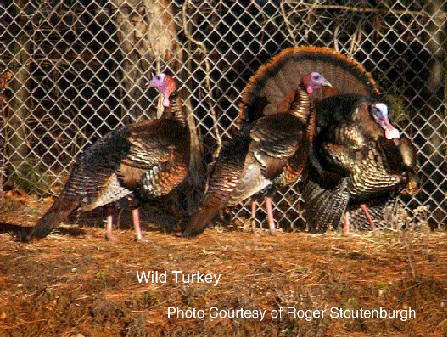
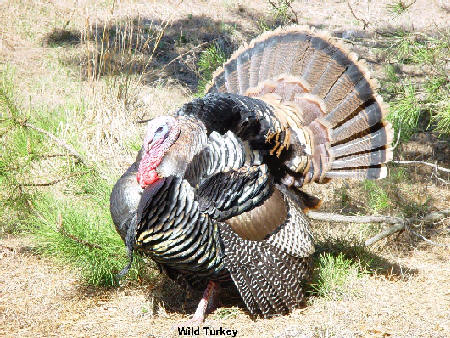
The wild turkey begins displaying as seen in the above photos in the early spring. Mating occurs in April and May.
Turkeys are ground nesters and place nests in areas with good vegetative cover, at the base of trees, or where camouflage is good. The hens lay between one and two dozen eggs, which hatch between mid-June to early-July.
The hens stay with the polts through the fall when they begin to group up into flocks for the winter months. At BNL the largest winter flock seen has been over 100 birds. In most cases flocks are between 10 and 30 birds but larger flocks can be occur.
Brookhaven Science Associates
Brookhaven Science Associates manages and operates Brookhaven National Laboratory on behalf of the U.S. Department of Energy's Office of Science. BSA is a partnership between Battelle and The Research Foundation for the State University of New York on behalf of Stony Brook University. | More
