


- Home
- Facilities
- Research
-
Working at CFN
- Arrival & Departure
- Reports & Publications
- Acknowledging Use of CFN Facilities
- Data Management
- The Guide to Brookhaven
Safety Procedures
- Operations Plan
- Experimental Safety Reviews (ESR)
- COSA Training
- Hours of Operation
- Laser System Qualification
- Transport of Hazardous Materials
- Vendor On-site Scheduling Procedure (PDF)
- Electrical Equipment Inspections
- News & Events
- People
- Jobs
- Contact
- Business
- Intranet
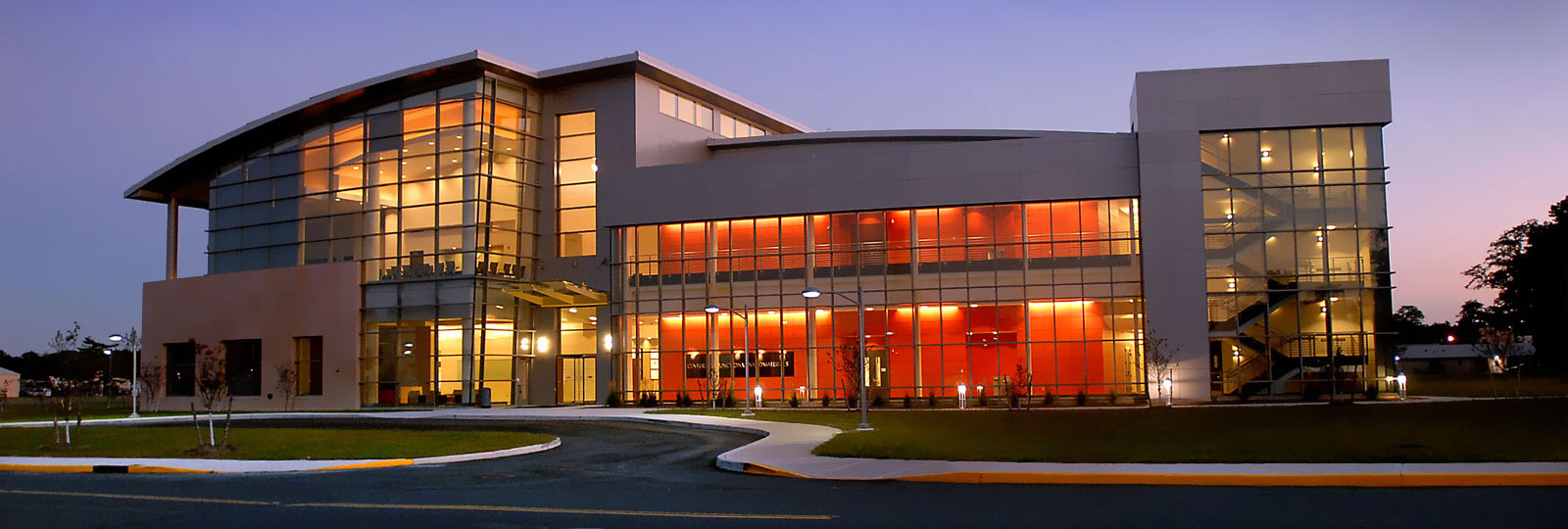
About the Center for Functional Nanomaterials
The Center for Functional Nanomaterials (CFN) is a Nanoscale Science Research Center operated for the U.S. Department of Energy at Brookhaven National Laboratory. As a national scientific user facility, the CFN provides users a research experience supported by top-caliber scientists and with access to state-of-the-art instrumentation. The CFN mission is advancing nanoscience, by being an essential resource for the worldwide scientific community and by carrying out transformative nanoscience research to support the energy, economic, and national security of the United States. Strategic partnerships are crucial to CFN mission success, including the strong synergy with the National Synchrotron Light Source II (NSLS-II), also located at Brookhaven.
Efforts are focused on developing nanomaterial synthesis-by-assembly methods and realizing functional material designs from polymer, nanoparticle, biomolecule-based, and 2D material components. Automation of the synthesis-by-assembly process will provide parallelism and reproducibility, facilitate assembly of increasingly complex architectures, provide control of assembly pathways, and allow incorporation of real-time feedback during processing. Advanced characterization and new methods to probe structure include nanoscale coherent X-ray beams at NSLS-II and 3D imaging of nanostructures by cryo- and in-liquid electron microscopy. Theory and simulation complement the experimental effort, including developing effective self-assembly strategies, assessing the inherent stability of resulting morphologies, and mapping the advantages and limitations imposed by kinetics.
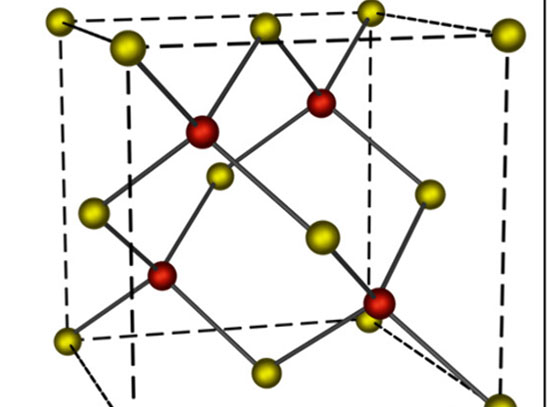
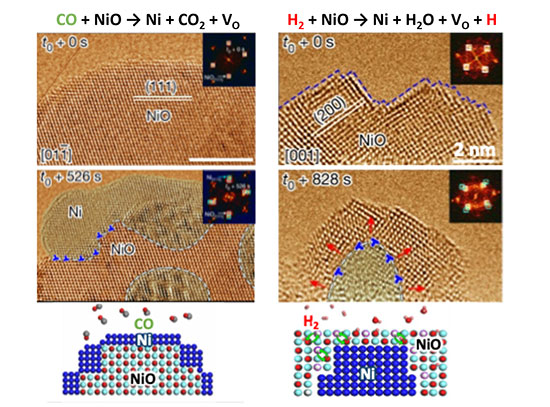
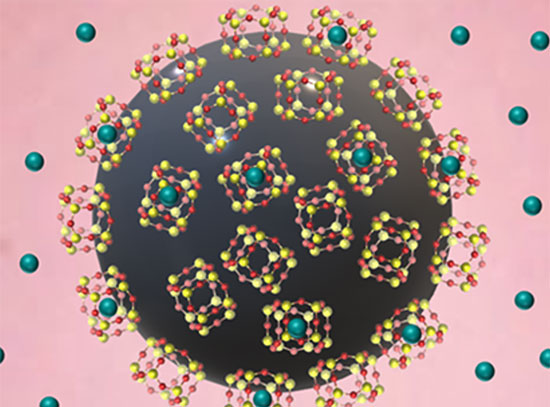
Research Highlights
News
Stay informed! Subscribe to iCFN, email newsletter of the Center for Functional Nanomaterials.
Research Facilities
Fabrication
Nanofabrication Facility
A class 100/1000 clean room with equipment to fabricate devices for nanoelectronics, nanophotonics, biomedical engineering, photovoltaics, x-ray optics, nanomagnetics and more.
Materials Synthesis and Characterization Facility
Includes laboratories for producing nanostructured materials and characterizing their basic structural, chemical, and optical properties.
Characterization
Electron Microscopy
Five transmission electron microscopes, two of which are capable of extreme levels of resolution.
Advanced UV and X-ray Probes
Endstations at the National Synchrotron Light Source II for surface spectro-microscopy and probing of complex materials at the molecular and nanoscale.
Advanced Optical Spectroscopy and Microscopy
Spectroscopy, microscopy, ultrafast optical spectroscopy, and ultrafast and nonlinear optical microscopy
Materials Synthesis and Characterization
Laboratories for producing nanostructured materials and characterizing their basic structural, chemical, and optical properties.
Proximal Probes
Laboratories for microscopy, spectroscopy, and probing of nanostructured materials including a suite of instruments for in situ microscopy and spectroscopy of surfaces and nanostructures under operating conditions.
Theory
Theory and Computation
Flexible computational infrastructure, software tools and theoretical consultation are provided to support modeling and understanding of the structure and properties of nanostructured materials.
Contact
-
Grace Webster
CFN User Administration Program & Outreach Coordinator
631-344-NANO (6266), gwebster@bnl.gov
User Administration Office
Brookhaven National Laboratory
P.O. Box 5000, Bldg. 735
Upton, NY 11973-5000
Nanoscale Science Research Centers
The Nanoscale Science Research Center (NSRC) Program operates a system of five coordinated Centers located in U.S. Dept. of Energy national laboratories across the United States. Prospective users are encouraged to explore the capabilities offered by the NSRC program. Learn more about NSRCs
