


- Home
-
Compliance
- Environmental Monitoring Plan
- Site Environmental Reports
Pollution Prevention
- Overview
-
Services
Field Sampling
- Overview
- Environmental Monitoring SOPs
- Staff
Env. Compliance Reps
- Process Assessments Forms
-
Resource Management
-
Groundwater Protection
-
Groundwater Protection
Program Overview
Documents and Reports
Groundwater Projects
Surface Projects
Land Use & Institutional Controls Mapping
Groundwater Status Reports
Contact
Reactor Decommissioning Projects
About
BGRR Science & Accomplishments
Celebrating DOE's Cleanup Accomplishments (PDF)
ContactBrookhaven Graphite Research Reactor (BGRR)
Brookhaven Graphite Research Reactor(BGRR) Overview
BGRR Complex Description
Decommissioning Decision
BGRR Complex Cleanup Actions
BGRR Documents
High Flux Beam Reactor (HFBR)
High Flux Beam Reactor (HFBR) Overview
HFBR Complex Description
Decommissioning Decision
HFBR Complex Cleanup Actions
HFBR Documents
-
- Contact
Reptiles
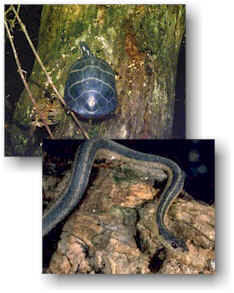
During comprehensive surveys conducted at BNL in 1994 and 1995, five species of reptiles were observed on transect surveys, and an additional five species were added as results of incidental observations. Along the terrestrial transects, the eastern box turtle was the most frequently observed reptile. Box turtles were found in all habitat types sampled including pine plantations, pitch pine/oak forests, fields and wetlands. The garter snake, milk snake, eastern Hognose Snake, northern brown snake, and black racer were found in upland habitats. The ribbon snake, garter snake, snapping turtle, painted turtle, and spotted turtle were found in wetland habitats. The snapping turtle and painted turtle were commonly observed along the Peconic river system. The spotted turtle was uncommon, as only a few shells from dead turtles were found in the headwater areas of the Peconic River upstream of the BNL Sewage Treatment Plant. Few snakes were found in uplands, the black racer was the most common species observed in this area. Other species including the eastern hognose snake, milk snake, and northern brown snake are represented on site by only one observation each. The low number of upland observations of terrestrial snakes partially due to the dry sandy habitat on the BNL site and possibly due to past use of pesticides. The eastern garter snake was the only snake found using an artificial hiding place.
Eastern Box Turtle (Terrapene carolina)
The box turtle is the only exclusively terrestrial turtle found on the BNL site. While relatively common in pine barrens habitats, box turtles are often killed by automobiles and brush fires. Box turtles are most frequently observed in spring months or after rain storms; they generally aestivate (remain dormant) in swampy areas during the warmer summer months. Box turtles are territorial: an individual turtle may spend its life in an area scarcely larger than a football field, provided habitat conditions remain favorable.
Reptiles observed on the BNL site
Reptiles listed in alphabetical order by scientific name.
TURTLES |
|
| Common Name | Scientific Name |
| Snapping turtle | Chelydra serpentina |
| Spotted turtle | Clemmys guttata |
| Painted turtle | Chrysemys picta |
| Box turtle | Terrapene carolina |
| Stinkpot turtle | Sternotherus odoratus |
SNAKES |
|
| Common Name | Scientific Name |
| Northern brown snake | Storeria dekayi |
| Eastern garter snake | Thamnophis sirtalis |
| Eastern ribbon snake | Thamnophis sauritus |
| Eastern hognose snake | Heterodon platyrhinos |
| Northern black racer | Coluber constrictor |
| Eastern milk snake | Lampropeltis triangulum |
