Polymer Solar Cells Employing Förster Resonance Energy Transfer
August 19, 2013
What is the Scientific Achievement?
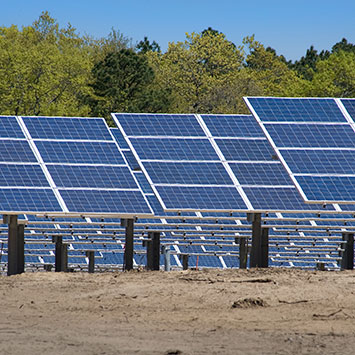
Next generation solar panels could yield substantially lower costs per kilowatt-hour with this technological development.
Two crucial tasks exist for realizing high-efficiency polymer solar cells: increasing the range of the spectral absorption of light and efficiently harvesting photo-generated excitons. In this work, Förster resonance energy transfer (FRET)-based heterojunction polymer solar cells that incorporate squaraine dye (SQ) were fabricated and investigated. The high absorbance of squaraine in the near-infrared region broadens the spectral absorption of the solar cells and assists in developing an ordered nano-morphology for enhanced charge transport. Femtosecond spectroscopic studies revealed highly efficient (up to 96%) excitation energy transfer from poly(3-hexylthiophene), also known as P3HT, to squaraine occurring on a picosecond timescale. A 38% increase in power conversion efficiency was realized to reach 4.5%; this finding suggests that this system has improved exciton migration over long distances. This architecture transcends traditional multiblend systems, allowing multiple donor materials with separate spectral responses to work synergistically, thereby enabling an improvement in light absorption and conversion. This discovery opens up a new avenue for the development of high-efficiency polymer solar cells.
Why Does This Matter?
A new energy transfer mechanism has been exploited for the first time, allowing significantly more efficient energy harvesting in P3HT/dye solar cells compared to P3HT-alone solar cells. Also, broadening the light absorption spectrum into the near-infrared region and developing nanoscale parts to the solar cell has improved the device.
Allowing different light-absorbing materials to work synergistically has led to well-ordered polymer networks without post-processing.
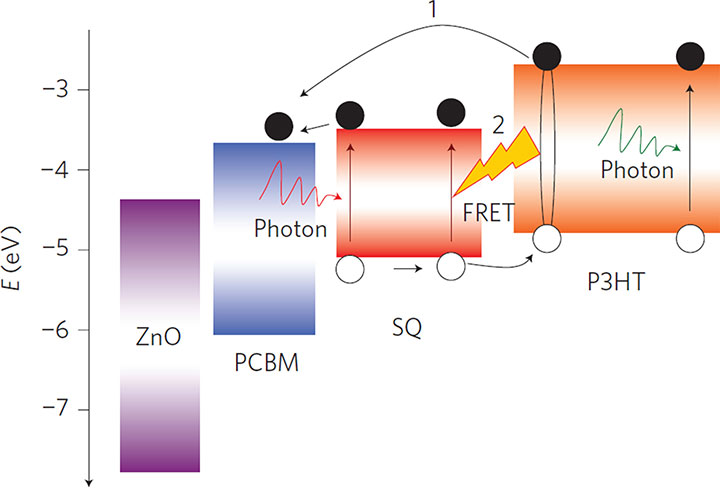
Energy level diagram of the components of the ternary blend solar cell highlighting pathways for charge generation.
What Are the Specifics?
- CFN Capability: CFN’s Advanced Optical Spectroscopy & Microscopy Facility was used to understand the energy conversion mechanism and rate of electronic transfer between the dye and polymer in the solar cells.
- The use of squaraine dye and FRET of charge carriers improved the efficiency of polymer solar cells. Femtosecond spectroscopic studies revealed highly efficient excitation energy transfer from P3HT to SQ occurring on a picosecond timescale. This suggested that this system has improved exciton migration over long distances.
- For the first time, FRET was exploited to enhance exciton harvesting in polymer bulk heterojunction solar cells.
Reference
Jing-Shun Huang1, Tenghooi Goh1, Xiaokai Li1, Matthew Y. Sfeir2, Elizabeth A. Bielinski3, Stephanie Tomasulo4, Minjoo L. Lee4, Nilay Hazari3, and André D. Taylor1, Polymer bulk heterojunction solar cells employing Förster resonance energy transfer, Nature Photonics 7, 479-485 (2013).
- Department of Chemical and Environmental Engineering, Yale University, New Haven, Connecticut 06511, USA
- Center for Functional Nanomaterials, Brookhaven National Laboratory, Upton, New York 11973, USA
- Department of Chemistry, Yale University, New Haven, Connecticut 06511, USA
- Department of Electrical Engineering, Yale University, New Haven, Connecticut 06511, USA
Acknowledgment of Support
This work was supported primarily by the SOLAR program of the National Science Foundation (NSF; DMR-0934520) and the Yale Climate and Energy Institute. A.D.T. acknowledges support from a NSF-CAREER award (CBET-0954985) and NASA (CT Space Grant Consortium). Research was carried out in part at the Centre for Functional Nanomaterials, Brookhaven National Laboratory, which is supported by the US Department of Energy, Office of Basic Energy Sciences (contract no. DE-AC02-98CH10886). The authors thank C. Schmuttenmaer, E. Yan and S. Wang for informative discussions.
2013-4233 | INT/EXT | Newsroom