Simple Method for Trapping of Xenon in Nanocages
January 28, 2026
 enlarge
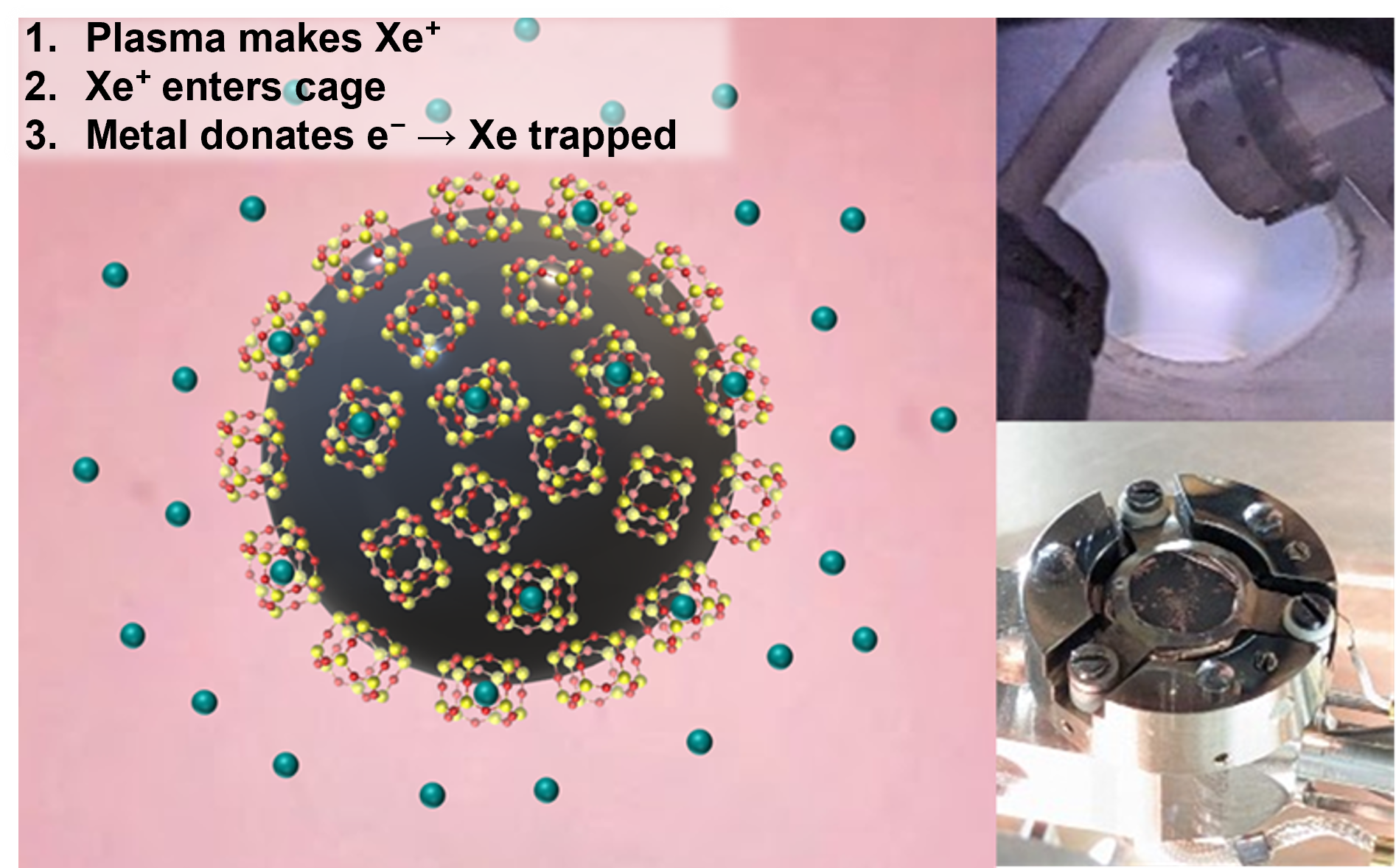
Left: metal powder particle coated with silicate nanocages exposed to Xe plasma. Top-right: sample holder during plasma exposure. Bottom-right: sample in the center of the holder.
Scientific Achievement
Demonstrated the trapping of xenon (Xe) atoms at room temperature in high–surface-area silica nanocages supported on metal powders using a simple plasma ionization method.
Significance and Impact
A scalable and cost-effective method for trapping Xe, a scarce noble gas relevant to nuclear energy, nuclear safety, non-proliferation, medical imaging, and space propulsion.
Research Details
Xenon is a rare noble gas that plays an important role in the efficiency and safety of nuclear reactors. It is also used in spacecraft propulsion, medical imaging, anesthetics, lighting, and other applications. Capturing xenon is critical because it is scarce and expensive, and its release from nuclear reactors poses safety risks. In this work, researchers showed that xenon atoms can be trapped at room temperature inside tiny silica cages deposited on metal powders. Instead of requiring a powerful synchrotron light source as part of the trapping experiment (as had been done in the past), the team used a simple plasma to ionize the xenon and capture it in the nanocages.
This demonstration represents a practical step forward: the method works with inexpensive cobalt powders as well as ruthenium and achieves trapping capacities like those in earlier synchrotron experiments using flat films. By simplifying both the materials and the ionization method, this research moves noble gas trapping technologies much closer to applications in energy, nuclear nonproliferation, isotope production, and even space exploration.
- High–surface-area trapping materials (~10 m²/g) made of silicate nanocages on Ru and Co powders.
- Plasma was used to ionize Xe, which was then neutralized and trapped inside nanocages.
- Xe trapping of 0.2–0.45 atoms per cage.
Publication Reference
L. Bilal, A. Khaniya, D. Olson, S. Moulton, A. Dameron, X. Tong, L. Ecker, D. Stacchiola, J. A. Boscoboinik, Small Science (2025), 2500136.
DOI: https://doi.org/10.1002/smsc.202500136
Acknowledgment of Support
Experiments were carried out at the Center for Functional Nanomaterials, Brookhaven National Laboratory, supported by the U.S. Department of Energy, Office of Basic Energy Sciences under Contract No. DE-SC0012704. Part of the research was supported by a Technology Commercialization Fund grant (TCF-20-20124) and by Brookhaven LDRD No. 22-050. Work was also supported by Battelle Savannah River Alliance, LLC under Contract No. 89303321CEM000080 with DOE. Additional contributions came from Forge Nano, Inc., where chemical vapor deposition experiments were performed (we acknowledge assistance by James Keane).
2026-22838 | INT/EXT | Newsroom