Novel Strain-Relief Mechanism Revealed by Multimodal Experiments and AI
April 28, 2026
 enlarge
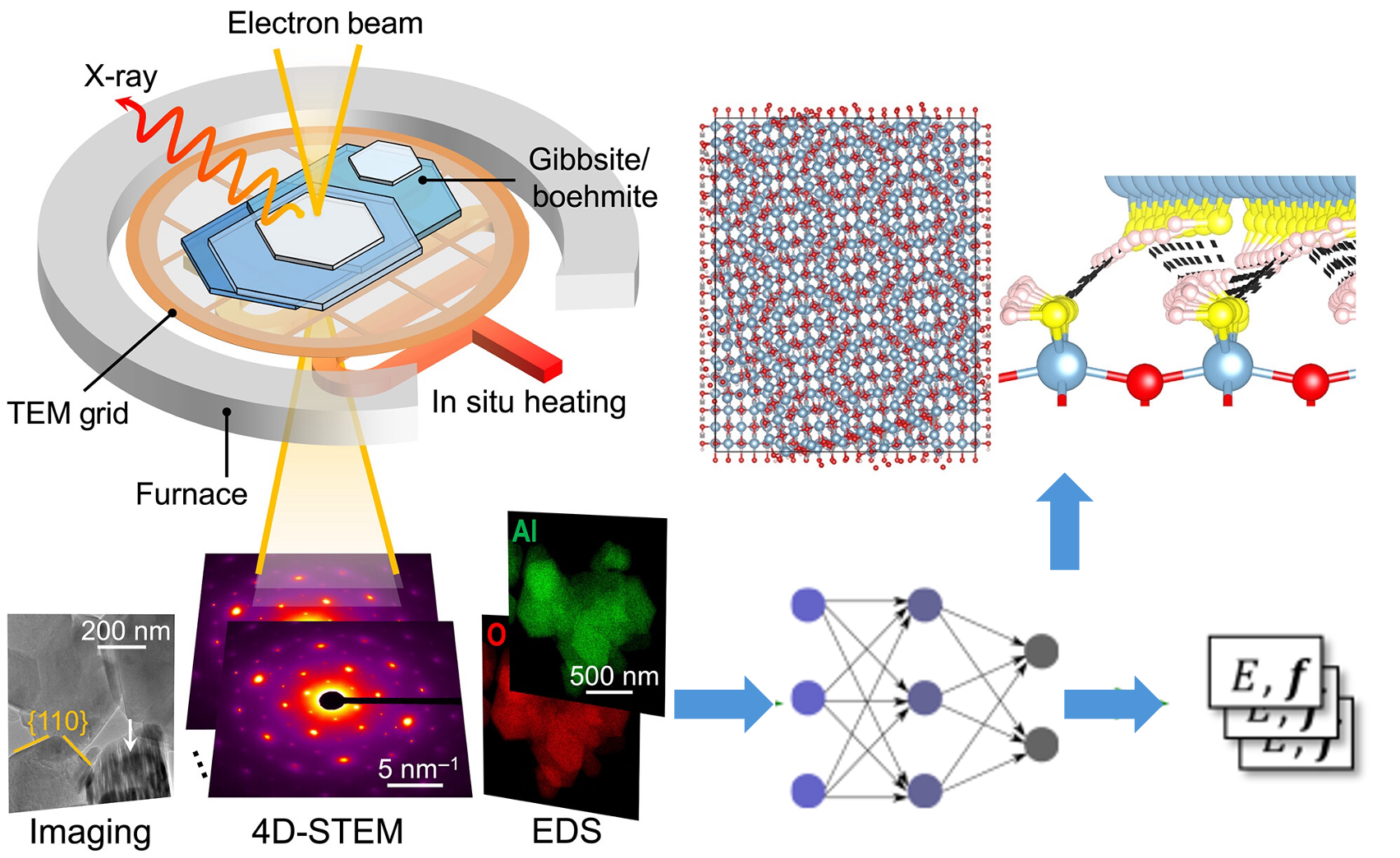
Multimodal experimental measurements combined with AI-accelerated simulations reveals novel strain-relief mechanism that forms Moiré patterns mediated by hydrogen bonds.
Scientific Achievement
Scientists from multiple institutions discovered a new strain-relief mechanism in Boehmite (g-AlOOH) that forms Moiré patterns. Unlike commonly observed Moiré structures in van der Waals (vdW) layered materials, this study observed a rare case of Moiré structures in non-vdW materials mediated by twisting of hydrogen bonds.
Significance and Impact
This work reveals a new mechanism for strain release in a layered material: two-dimensional twisting governed by hydrogen bonding. It expands the understanding of how nanoscale strain evolves and transforms materials, with potential implications for advanced material design, geoscience, and other strain-driven systems.
Research Details
Strain engineering, enabling the precise control over structure and functional properties, is a key strategy for the design of advanced materials. However, the mechanisms governing strain evolution and release at the nanoscale remain largely unexplored. In this study, we leverage in situ heating transmission electron microscopy and synchrotron x-ray spectroscopy to investigate the strain relaxation pathways of boehmite (γ-AlOOH) at 575 kelvin by revealing real-time structural dynamics. Through tracking the moiré pattern evolution, we identify distinct strain release mechanisms, including layer twisting, defect formation, and domain restructuring. Our neural network potential calculations reveal that energy fluctuations at small twist angles are dominated by an interference-like interaction modulation of hydrogen bonds between boehmite interlayers, with metastable twisted structures corresponding to local minima of the potential energy landscape. This work establishes a previously unidentified paradigm of two-dimensional layer twisting mediated by hydrogen bonding, offering insights into strain-driven transformation mechanisms, and thus may have broad implications for strain in material and earth sciences.
- Synthesis and multimodal characterization were carried out by a team of scientists from multiple institutes.
- Neural network potential model, developed using theory and computational resources at CFN and CDS, explains the mechanism of hydrogen-bond twisting.
Publication Reference
- https://www.science.org/doi/full/10.1126/sciadv.ady6869
- https://eesa.lbl.gov/2025/11/10/studying-materials-science-at-the-nanoscale-to-inform-geothermal-development/
- DOI: 10.1126/sciadv.ady6869
- OSTI: https://www.osti.gov/pages/biblio/3003353
Acknowledgment of Support
This work was supported by the US Department of Energy, Office of Science, supporting the Energy EarthshotTM Initiative, as part of the “Center for Coupled Chemo-Mechanics of Cementitious Composites for EGS (C4M)” project at Brookhaven National Laboratory and at Lawrence Berkeley National Laboratory under contract number 2026-BNL-IS012-FUND, and the U.S. Department of Energy, Office of Science, Office of Basic Energy Sciences, Materials Sciences and Engineering Division under Contract No. DE-AC02-05-CH11231 within the in-situ TEM (KC22ZH) program. Q. Zhe acknowledges support from The Green Initiative Fund and The CITRIS Workforce Innovation Fellowship, UC Berkeley. This work was also partially supported by National Technology &Engineering Solutions of Sandia LLC under award number DE-NA0003525.
Part of the work was carried out as user projects at the Molecular Foundry at Lawrence Berkeley National Laboratory, a user facility also funded by the US Department of Energy under contract no. DE-AC02-05-CH11231. This research also used 7-BM (QAS), 28-ID-1 (PDF), and 28-ID-2 (XPD) beamlines at the National Synchrotron Light Source II (NSLS-II), the Theory and Computational resources of the Center for Functional Nanomaterials (CFN), and computational resources of the Scientific Data and Computing Center, at Brookhaven National Laboratory. NSLS-II and CFN are US DOE Office of Science User Facilities operated for the DOE Office of Science by Brookhaven National Laboratory under contract no. DE-SC0012704. J.M.R. thanks B. Fashina of Sandia National Laboratories for a detailed technical review and thoughtful comments. Research was performed in part at the Texas A&M University System Center for Infrastructure Renewal (CIR). This article has been authored by an employee of National Technology & Engineering Solutions of Sandia LLC, under contract no. DE-NA0003525 with the US Department of Energy (DOE).
2026-23191 | INT/EXT | Newsroom