AI Enables Low-Dose, Real-Time Atomic Imaging
July 23, 2026
Scientific Achievement
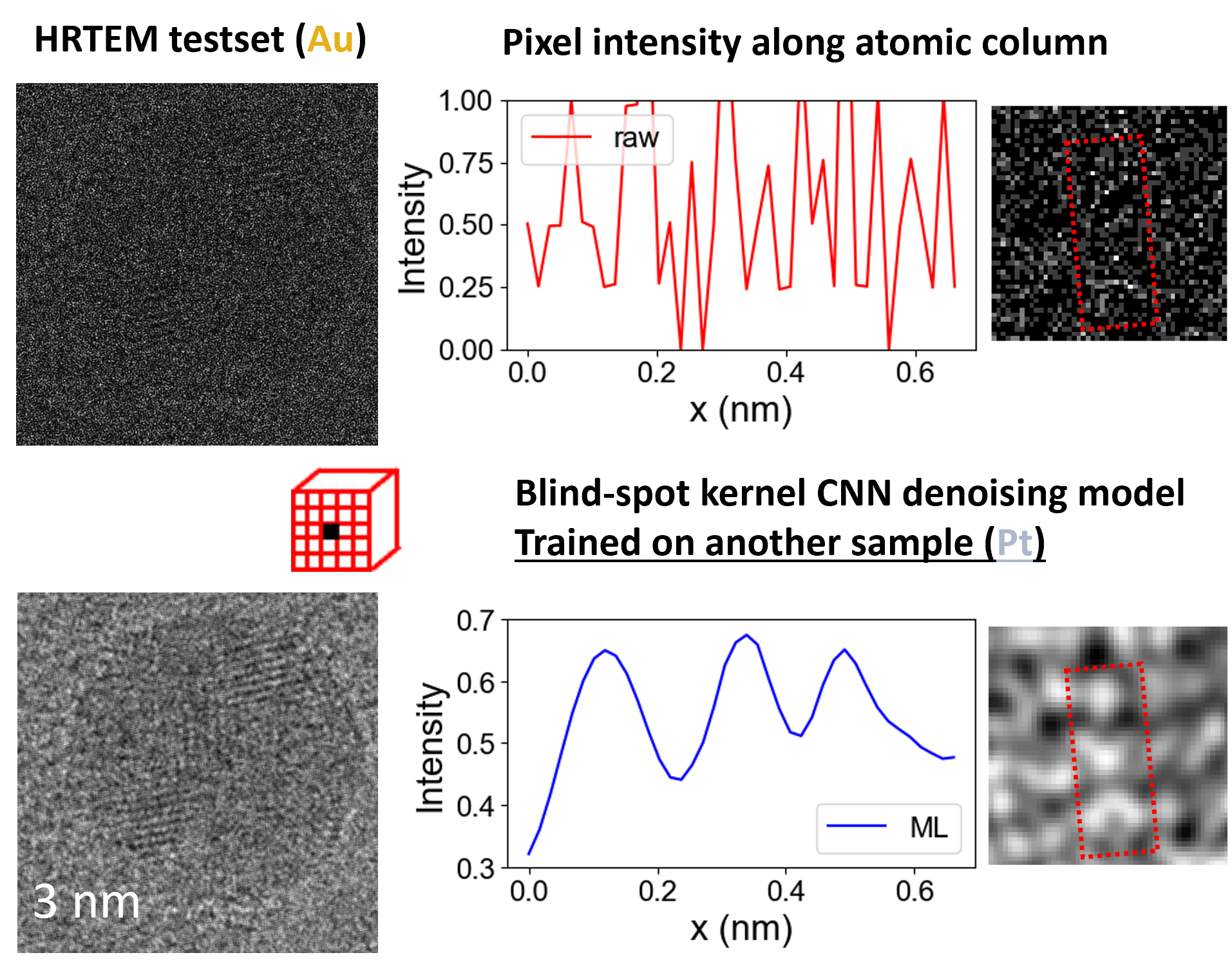
The study develops a machine learning model that denoises high-resolution transmission electron microscopy images without the need of retraining for completely different samples. The approach delivers high-quality images in milliseconds, enabling real-time analysis during in-situ experiments.
Significance and Impact
This work overcomes a major challenge in in situ electron microscopy by providing fast, accurate image denoising without sacrificing temporal resolution. The model enables lower electron doses, reducing beam-induced sample damage while improving visualization of atomic-scale processes. Its speed and robustness make it well suited for next-generation real-time microscopy and AI-assisted materials characterization.
Research Details
- Denoising models are crucial for low electron dose in situ HRTEM at high temporal resolution that lead to low signal-to-noise ratio.
- Existing ML models are applicable only to their training dataset and need machine learning expertise to retrain it on new datasets, which makes it difficult for CFN users to use them for in situ denoising.
- We develop a new denoising model that is computationally efficient and generalize well to datasets with very different noise and signal distributions than the training dataset.
- Our comparative study of current model with other popular ML models show our model lead to 6~7 orders of magnitude higher PSNR for out-of-distribution datasets compared to other models like Unsupervised Deep Video Denoising model or Noise2Void.
- The model inference speed for 4K images is in the order of milliseconds, making it viable for in situ applications. Now, in turn, it can help hardware development, allowing even lower electron dose, increase time resolution to sub millisecond regime.
- The real-time analysis of nanoscale processes can improve our understanding of catalysis, oxidation, and nanoparticle dynamics.
- Blind-spot convolutional neural network as a self-supervised framework.
- Compact network (867 parameters) delivers excellent out-of-distribution (OOD) generalization.
- Decoupled design for drift corrections enhances OOD performance.
- The images were collected using electron microscopy at CFN. The models were trained using theory and computational resources at CFN.
Publication Reference
Brian Lee, Meng Li, Judith C. Yang, Dmitri N. Zakharov, and Xiaohui Qu. "Machine learning pipeline for denoising low signal-to-noise ratio and out-of-distribution transmission electron microscopy datasets." npj Comput Mater (2026).
https://www.nature.com/articles/s41524-026-02193-9
DOI: https://doi.org/10.1038/s41524-026-02193-9
Acknowledgment of Support
This research was supported by the U.S. Department of Energy program “Electron Distillery 2.0: Massive Electron Microscopy Data to Useful Information with AI/ML.” This research used Electron Microscopy and Theory and Computation resources of the Center for Functional Nanomaterials (CFN), which is a U.S. Department of Energy Office of Science User Facility, at Brookhaven National Laboratory under Contract No. DE-SC0012704.
2026-23210 | INT/EXT | Newsroom