Interpretable Machine Learning Bridges Data-driven Prediction and Spectroscopic Insights
July 23, 2026
 enlarge
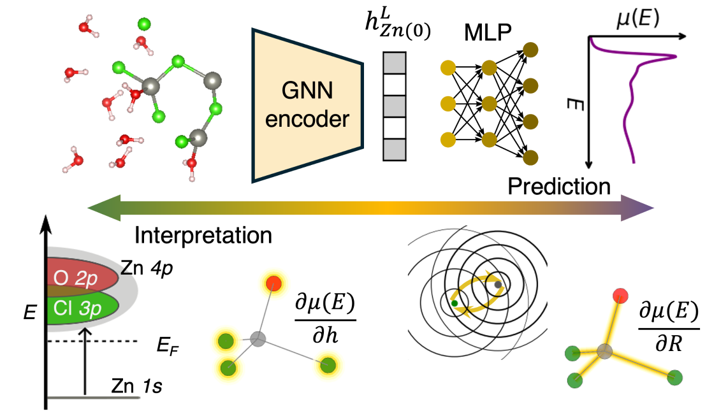
Top: GNN model predicts XAS from atomic structures. Bottom: Gradient-based ligand and bond-length attributions show that the model learns physically meaningful structure-spectrum relationships.
Scientific Achievement
Scientists developed a physics-based, interpretable graph neural network (GNN) that predicts Zn K-edge X-ray absorption spectroscopy (XAS) of aqueous ZnCl2 from atomic structures. Gadient-based attribution analysis, correlated to orbital hybridization and photoelectron scattering, showed that the model learns physically meaningful structure-spectrum relationships.
Significance and Impact
This work bridges data-driven prediction with electronic-structure theory, establishing a general paradigm for interpretable machine learning (ML) that links atomic structure, electronic structure, and spectroscopic observables.
Research Details
- XAS provides detailed, element-specific information on local atomic and electronic structures and is widely used to gain mechanistic understanding of complex chemical environments.
- ML is a powerful tool for predicting spectroscopic observables from atomic structures, but its broader impact depends on making model predictions interpretable in terms of physical and chemical principles.
- We introduce a physics-guided GNN model that predicts Zn K-edge XAS spectra of aqueous ZnCl2 Training data are generated from ab initio XAS calculations on molecular dynamics snapshots obtained using a neural network interatomic potential.
- The GNN reproduces experimental spectra across concentrations from dilute (<0.1 m) to highly concentrated (30 m, “water-in-salt”) regimes and scales efficiently to large, disordered liquid systems beyond the reach of conventional ab initio
- Ligand-specific attributions reflect orbital hybridization patterns derived from density functional theory; bond-length attributions recover spectral shifts consistent with the multiple-scattering theory.
- This work bridges data-driven prediction with electronic-structure theory, establishing a general paradigm for interpretable ML that links atomic structure, electronic structure, and spectroscopic observables.
Publication Reference
Chuntian Cao, Boyang Li, Armando Rodriguez Campos, Alexis Pace, Joshua J. Kas, Xifan Wu, Lu Ma, Dali Yang, Wei Xu, Shinjae Yoo, Esther S. Takeuchi, Kenneth J. Takeuchi, Shan Yan, Amy C. Marschilok, and Deyu Lu, Deciphering the Solvation Structure of Aqueous ZnCl2 Solutions from X-ray Absorption Spectra Using the Interpretable Graph Neural Network. The Journal of Physical Chemistry B (2026).
https://pubs.acs.org/doi/full/10.1021/acs.jpcb.6c00464
DOI: 10.1021/acs.jpcb.6c00464
OSTI: https://www.osti.gov/biblio/3375225
Acknowledgment of Support
This study was funded by the U.S. Department of Energy, Office of Science, Basic Energy Sciences, through Contract No. DE-SC0012704, under the Chemical and Materials Sciences to Advance Clean-Energy Technologies and Transform Manufacturing (CEM) program. This research used Theory and Computational resources at the Center for Functional Nanomaterials, and beamline 7-BM, Quick X-ray Absorption and Scattering (QAS) of the National Synchrotron Light Source II, which are U.S. Department of Energy (DOE) Office of Science User Facilities operated for the DOE Office of Science by Brookhaven National Laboratory under Contract No. DE-SC0012704. This research used resources of the National Energy Research Scientific Computing Center (NERSC), a Department of Energy User Facility using NERSC award ERCAP0030552 and ERCAP0032397. X.W. acknowledges support from the National Science Foundation through Grant No. DMR-2053195 for their intellectual input to deep potential molecular dynamics of ZnCl2 solutions. J.J.K. acknowledges support from the Theory Institute for Materials and Energy Spectroscopies (TIMES) at SLAC, funded by the U.S. Department of Energy, Office of Basic Energy Sciences, Division of Materials Sciences and Engineering under Contract No. DE-AC02-76SF00515, for their contribution to spectral function calculation and many-body shake-up correction. We thank Dr. Shubha R. Kharel for the fruitful discussions. E.S.T. acknowledges support as the William and Jane Knapp Chair in Energy and the Environment.
2026-23211 | INT/EXT | Newsroom