Vacancy-Driven Mechanisms in Hydrogen Reduction of Iron Oxides
April 28, 2026
 enlarge
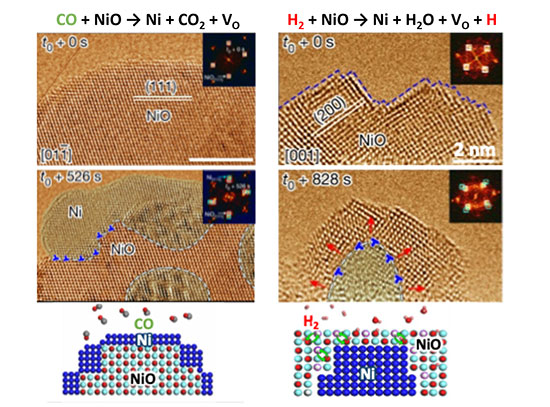
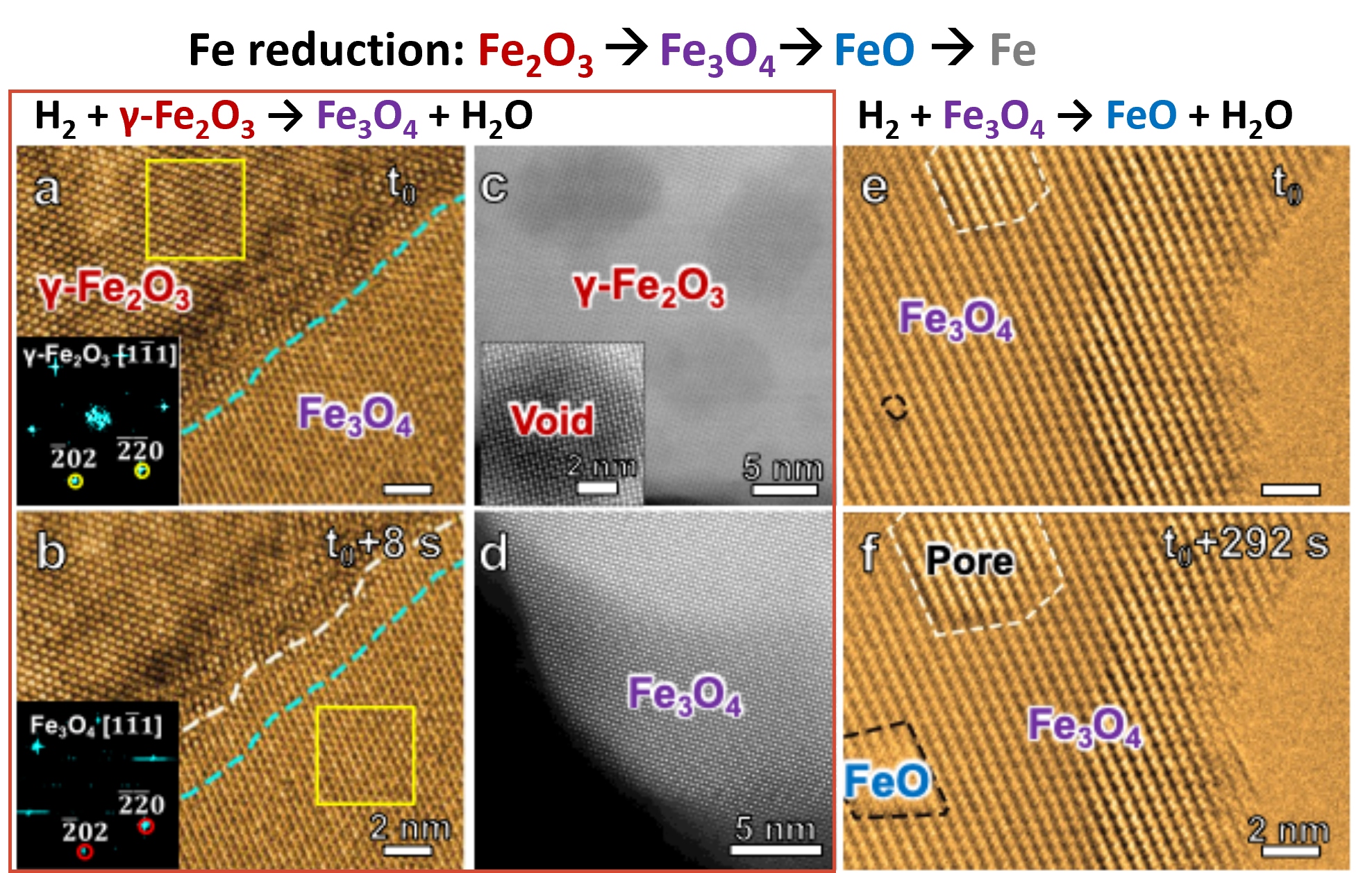
(a, b) In situ E-TEM images of γ-Fe2O3 reduction under H2, showing γ-Fe2O3 / Fe3O4 interface migration. (c, d) STEM-HAADF images of γ-Fe2O3 and Fe3O4, showing intrinsic Fe vacancies in γ-Fe2O3 , and fully occupied Fe sublattice in Fe3O4. (e, f) In-situ E-TEM images of Fe3O4 reduction, showing growth of structural pore (white outline) and FeO (black outline).
Scientific Achievement
Uncovered how cation and anion vacancy dynamics control hydrogen-induced reduction pathways and microstructure evolution in iron oxides at the atomic scale.
Significance and Impact
These insights reveal how controlling atomic-scale defects can improve metal production, enhance catalysts, and design more resilient oxide materials for energy applications.
Research Details
This collaborative study between Binghamton University, Brookhaven National Laboratory, and the National Institute of Standards and Technology uncovers how atomic-scale defects control the reduction of iron oxides, a key process in hydrogen-based ironmaking.
Iron reduction is a complex, multi-step transformation, but the atomic-scale mechanisms governing this process have remained unclear. Using in situ environmental transmission electron microscopy at the Center for Functional Nanomaterials, researchers directly observed how iron oxides evolve under hydrogen at elevated temperature, capturing real-time structural changes at the nanoscale.
The study reveals that subtle differences in defect structure lead to fundamentally different reaction pathways. In γ-Fe2O3, intrinsic iron vacancies promote the clustering of oxygen vacancies during reduction. This clustering leads to the formation of nanopores, trapping defects within the material and limiting the reaction to a moving interface. As a result, the transformation becomes slower and spatially localized.
In contrast, Fe3O4 lacks intrinsic iron vacancies, and oxygen vacancies remain more uniformly distributed. This prevents clustering and allows the reduction to proceed throughout the material, enabling a bulk transformation to FeO.
These findings establish a simple but powerful principle: vacancy clustering drives interface-limited transformations, while uniformly distributed vacancies enable bulk reactions.
By linking atomic-scale defect behavior to macroscopic reaction pathways, this work provides new insight into controlling reduction kinetics. The results offer guidance for defect engineering strategies to improve efficiency in hydrogen-based metal production and to design oxide materials with tailored reactivity and stability.
- In-situ environmental transmission electron microscopy (E-TEM) was used to monitor the atomic-scale structural evolution of γ-Fe2O3 and Fe3O4 under H2.
- γ-Fe2O3: intrinsic Fe vacancies promote vacancy clustering, leading to nanopore formationà interface-reaction-limited transformation at γ-Fe2O3/Fe3O4 boundary
- Fe3O4: maintains a dense structureà uniform O vacancy increase and bulk reduction to FeO.
- Ex-situ scanning transmission electron microscopy (STEM) and density functional theory modeling cross-validated the in situ ETEM observations.
Publication Reference
Y. Wu, D. Wu, W. Zhu, X. Chen, Z. Zhou, Z. Liang, S. Ye, M. Li, X. Tong, K. Kisslinger, S. Hwang, D. Zakharov, R. Sharma, J.C. Yang, G.W. Zhou, Atomically Revealing Bulk Point Defect Dynamics in Hydrogen-Driven γ-Fe2O3 → Fe3O4 → FeO Transformation, Advanced Functional Materials 36 (20), e19406 (2026).
DOI: https://doi.org/10.1002/adfm.202519406
Acknowledgment of Support
This work was supported by the U.S. National Science Foundation under Grant No. DMR-2303712. S. Ye acknowledges support from the U.S. Department of Energy (DOE), Office of Basic Energy Sciences, Division of Materials Sciences and Engineering, under Award No. DE-SC0001135. This research utilized the electron microscopy and theory/computation resources at the Center for Functional Nanomaterials, a U.S. DOE Office of Science User Facility at Brookhaven National Laboratory, under Contract No. DE-SC0012704. Additional computational support was provided by the Spiedie cluster at the State University of New York at Binghamton.
2026-23192 | INT/EXT | Newsroom