Electrode Phase Engineering Improves Reliability of Ultrathin TaOx Memristors for Neuromorphic Computing
July 23, 2026
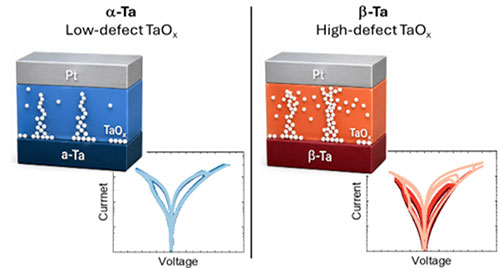
(Left) UV-ozone (UVO) oxidation of cubic α-Ta forms a dense, near-stoichiometric memristor layer with a significantly reduced switching stochasticity and endurance compared to tetragonal β-Ta (right) that forms oxygen-deficient oxides with higher trap density.
Scientific Achievement
Ta crystalline phase was discovered to control memristor switching behavior in ultrathin TaOx. UV-ozone (UVO) oxidation of cubic α-Ta forms a near-stoichiometric TaOx layer, whereas tetragonal β-Ta forms oxygen-deficient oxides with higher trap density. The former reduces switching stochasticity and enhances endurance, enabling synaptic device operation.
Significance and Impact
This work identifies room-temperature UVO and electrode phase engineering as a practical strategy to improve the performance and reliability of ultrathin TaOx memristors, enabling more robust resistive memory for next-generation in-memory and neuromorphic computing.
Research Details
The study demonstrates that the crystallographic phase of the Ta electrode governs defect formation and switching reliability in UV-ozone (UVO)-treated TaOx devices. Room-temperature UVO oxidation of cubic α-Ta forms a dense, near-stoichiometric switching layer with a controlled oxygen-vacancy reservoir, whereas tetragonal β-Ta forms more oxygen-deficient oxides with higher trap density. Consequently, α-Ta-based devices exhibit reduced device-to-device and cycle-to-cycle variability and improved endurance, enabling robust synaptic operation for neural networks, compared with β-Ta counterparts. Structural, chemical, and electrical analyses reveal that phase-dependent defect distributions govern filament evolution and switching stability. These findings establish electrode phase engineering as a key strategy for achieving reliable ultrathin TaOx memristors for in-memory and neuromorphic computing applications.
Publication Reference
D.H. Lee, S. Yang, W.-I. Lee, K. Kisslinger, X. Tong, C.-Y. Nam, ACS Appl. Mater. Interfaces 18, 35599(2026).
https://doi.org/10.1021/acsami.6c04830
Acknowledgment of Support
This research used the Nanofabrication, Materials Synthesis and Characterization, Electron Microscopy, and Proximal Probes Facilities of the Center for Functional Nanomaterials (CFN), which is a U.S. Department of Energy Office of Science User Facility, at Brookhaven National Laboratory under Contract No. DE-SC0012704.
2026-23209 | INT/EXT | Newsroom